Gold Mean Reversion Indicator for XAUUSD Swing Trading [H1 TradingView] – Ornstein-Uhlenbeck Exhaustion Model Explained
I built this indicator after watching Gold traders lose money buying tops and shorting bottoms for years. The Gold Mean Reversion v8 uses the Ornstein-Uhlenbeck stochastic process – the same mathematical model used by quantitative hedge funds – to tell you exactly when XAUUSD has gone too far, too fast, and is about to reverse. Here’s how it works, what makes it different from everything else on TradingView, and how you can use it to catch major Gold tops and bottoms on the H1 timeframe.
Contents
- 1. What the Gold Mean Reversion Indicator Actually Does
- 2. Why This Isn’t Another Bollinger Band Indicator
- 3. The Math: Ornstein-Uhlenbeck Process and Z-Score
- 4. Signal Types – What Each Triangle Means on Your Chart
- 5. How to Read the Chart: Backgrounds, Panels and Filters
- 6. The Recommended H1 Swing Trading Workflow
- 7. Multi-Timeframe Edge: Combining H1 with the 1M Scalper
- 8. Key Settings Explained (With Recommended Values)
- 9. Real Trade Examples – Signals That Actually Worked
- 10. How to Get Access (Invite Only)
- 11. FAQ: 6 Questions Every Gold Trader Asks
1. What the Gold Mean Reversion Indicator Actually Does
Let me be direct. Most indicators on TradingView will tell you Gold is “overbought” when RSI hits 70. Helpful? Not really. Gold has spent entire weeks above RSI 70 without pulling back a single dollar. Overbought is not the same as “about to reverse.”
The Gold Mean Reversion v8 takes a fundamentally different approach. It doesn’t just look at a single oscillator. It builds a statistical model of Gold’s price behavior using the Ornstein-Uhlenbeck stochastic process – a method originally used in physics and later adopted by quantitative hedge funds for pairs trading and statistical arbitrage.
In plain language, here’s what it does: it calculates Gold’s “fair value” based on an adaptive mean, then measures how far the current price has deviated from that mean in standard deviations (the Z-Score). When that deviation reaches extreme levels – and the move shows measurable signs of exhaustion – the indicator fires a signal.
The one-line version: This indicator tells you when Gold has gone too far, too fast – and the math says a snapback is statistically inevitable. It catches the tops and bottoms that most traders miss because they’re still following the trend.
The H1 version is designed specifically for swing traders who are patient enough to wait for the right setup. It produces 3 to 5 normal signals per month and only 2 to 4 extreme exhaustion signals per year. Every signal that fires has passed through multiple independent filters. There’s no noise. No constant buy/sell arrows cluttering your chart.
2. Why This Isn’t Another Bollinger Band Indicator
I know what you’re thinking. “Mean reversion? That’s just Bollinger Bands with extra steps.” I thought the same thing when I started building this. Then I spent over 20 iterations testing on live Gold charts and learned exactly why standard mean reversion tools fail on Gold specifically.
Bollinger Bands fire signals whenever price touches the upper or lower band. On Gold, this happens constantly. During the rally from $3,900 to $5,600, price touched the upper Bollinger Band dozens of times – and kept going higher every single time. Each touch was a “sell signal” that would have destroyed your account.
The Gold Mean Reversion v8 is built with five layers of protection against exactly this problem:
| Feature | Bollinger Bands / RSI | Gold Mean Reversion v8 |
|---|---|---|
| Statistical model | Fixed standard deviation bands | Ornstein-Uhlenbeck with half-life estimation |
| Mean reversion check | None – assumes price always reverts | OU model confirms mean-reverting regime before signals fire |
| Trend filter | No built-in trend awareness | Multi-timeframe Schmitt trigger with hysteresis |
| Exhaustion check | Overbought/oversold only | 5-component exhaustion verification system |
| Regime detection | None | Squeeze detection, gap filter, sigma expansion |
| False signals in trends | Constant – fires against the trend | Suppressed – trend filter blocks counter-trend signals |
| Signal frequency (H1) | Multiple per day | 3-5 per month (normal), 2-4 per year (extreme) |
From real trading experience: The biggest breakthrough came when I added the Schmitt trigger logic for the trend filter. Standard trend detection flips back and forth during choppy markets, generating whipsaw after whipsaw. The hysteresis mechanism requires the trend to prove itself before flipping state – and that one change eliminated most false signals during Gold’s notorious choppy consolidation phases.
3. The Math Behind It: Ornstein-Uhlenbeck Process and Z-Score
I’m going to explain the math in a way that actually makes sense for traders, not just quants. If you want to skip this section, go ahead – you don’t need to understand differential equations to use the indicator. But if you’re the type of trader who needs to know why something works before trusting it with your money, keep reading.
The Ornstein-Uhlenbeck process
The core model is described by this equation:
dX(t) = theta (mu – X(t)) dt + sigma dW(t)
Where:
theta = speed of mean reversion – how fast price gets pulled back toward the mean. Estimated via AR(1) regression on price data.
mu = long-term equilibrium mean – the “fair value” Gold is orbiting around. Calculated using an adaptive EMA.
sigma = volatility of the process – how wildly price swings around the mean.
W = Wiener process – the random noise component (the market’s unpredictability).
What this equation is saying, in trader language: price always gets pulled back toward a mean, but noise pushes it away. The indicator estimates how strong that pull is (theta) and how far price has wandered (the Z-Score). When the math says “this deviation is unsustainable,” a signal fires.
The half-life of mean reversion
Here’s where it gets interesting. The indicator estimates the half-life – the number of bars it takes for half of the deviation to close. This uses the formula:
H = -ln(2) / ln(1 + beta)
Where beta is the AR(1) coefficient from regressing deltaX(t) = alpha + beta*X(t-1) + epsilon. A finite, positive half-life confirms that Gold is actually in a mean-reverting regime – not just trending endlessly in one direction. Signals only fire when this statistical test passes.
This is critical. During a parabolic Gold rally, the half-life goes to infinity – the model correctly identifies that the market isn’t mean-reverting at all. So the indicator shuts up and waits. No signals, no false trades. Only when Gold enters a genuine mean-reverting regime does the engine come alive.
Z-Score: measuring deviation in standard deviations
Z = (Price – mu) / sigma
When |Z| exceeds 2.0, price is 2 standard deviations from the mean – a statistically significant deviation (only 5% probability under normal distribution). When |Z| exceeds 3.0, it’s a less than 0.3% probability event – an extreme anomaly. These are the high-conviction extreme signals.
Want a deeper understanding of Z-Score in trading? This Investopedia article on Z-Score explains the statistical foundations.
4. Signal Types – What Each Triangle Means on Your Chart
The indicator generates four types of actionable signals. I’ve designed them to be instantly readable – no ambiguity, no interpretation needed. If there’s a triangle on your chart, the indicator is telling you something specific.
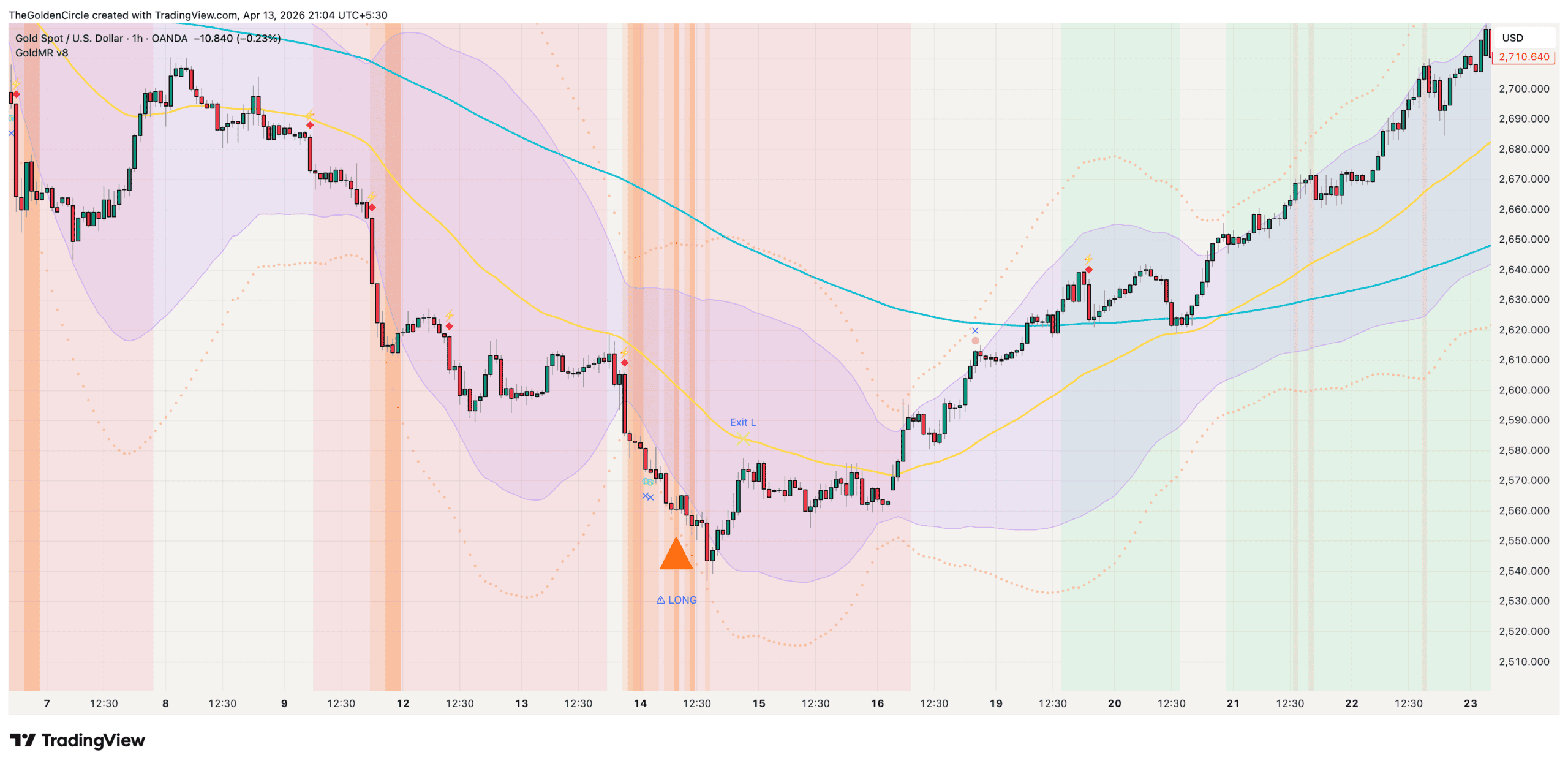
▲ LONG – Normal with-trend mean reversion buy. Price dropped 2 standard deviations below the mean in a bullish regime. Bread-and-butter trade.
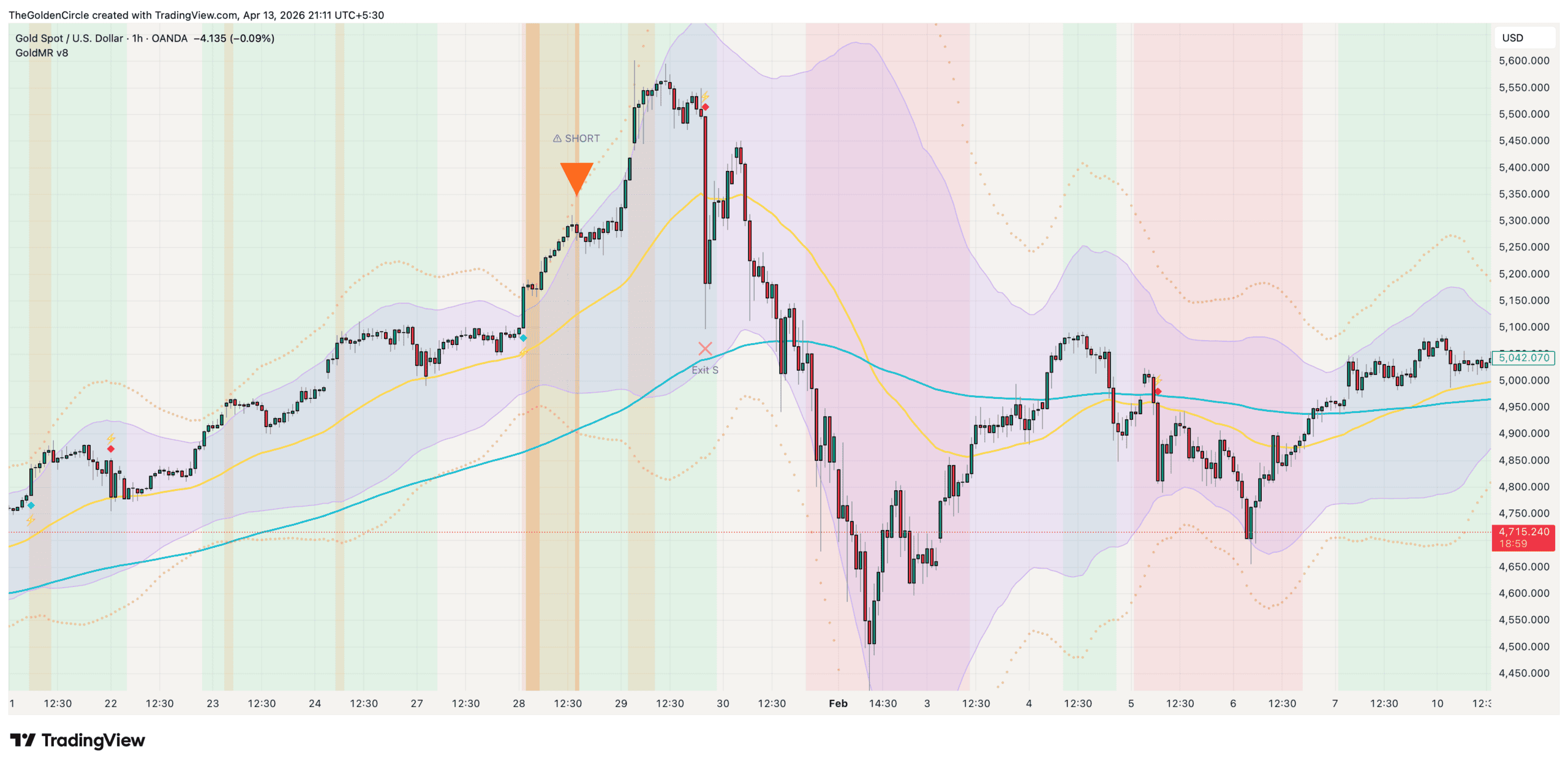
▼ SHORT – Normal with-trend mean reversion sell. Price pushed 2 standard deviations above the mean in a bearish regime. Clean reversal entry.
⚠ EXTREME – Exhaustion-confirmed signal. Price hit 3 standard deviations+ or 5+ ATR from mean with confirmed stalling. Rare. High conviction. Career trades.
✕ EXIT – Z-Score reverted toward zero. Close your position. This is your take-profit signal – the mean reversion is complete.
The golden rule of this indicator: No triangle = no trade. If you don’t see a triangle on your chart, the indicator is watching and waiting. Trust the silence. The blocked signals (marked with small x) are shown for transparency – they tell you “a signal almost fired but a filter caught it.” That’s the system working.
About extreme signals – why they’re so rare and so valuable
The extreme signals fire only 2 to 4 times per year on the H1 timeframe. When one appears, it means five independent checks have all confirmed exhaustion simultaneously:
The price has reached a Z-Score of 3.0+ (or 5+ ATR distance from the mean as a backup when sigma expands during parabolic moves). The RSI has spent multiple bars in the overbought or oversold zone. Candlestick patterns show momentum stalling. The rate of price acceleration is declining. And the volume profile matches historical exhaustion signatures.
When all five line up, you’re looking at what I call a “career trade” – the kind of signal that catches a $100 to $500 Gold move. These are the signals that caught major tops like $4,100 in October 2025 and $5,500 in January 2026. Both reversed hundreds of dollars.
5. How to Read the Chart: Backgrounds, Info Panel and Filters
One of the things I’m most proud of in this indicator is the visual system. Every piece of information is colour-coded so you can read the chart at a glance without opening any menus.
Background colors: your trend and regime dashboard
Green background – Bullish regime. Focus on LONG signals from dips.
Red background – Bearish regime. Focus on SHORT signals from rallies.
Yellow background – BB Squeeze detected. Stay out entirely. Breakout direction is uncertain.
Teal background – Gap detected. Wait for the mean to catch up before signals become reliable.
Orange background – Extreme zone detected but not yet confirmed by exhaustion checks.
When the background is green, the trend filter is bullish – focus on LONG signals and treat SHORT signals with extra caution. When it’s red, the opposite applies.
The info panel: complete transparency
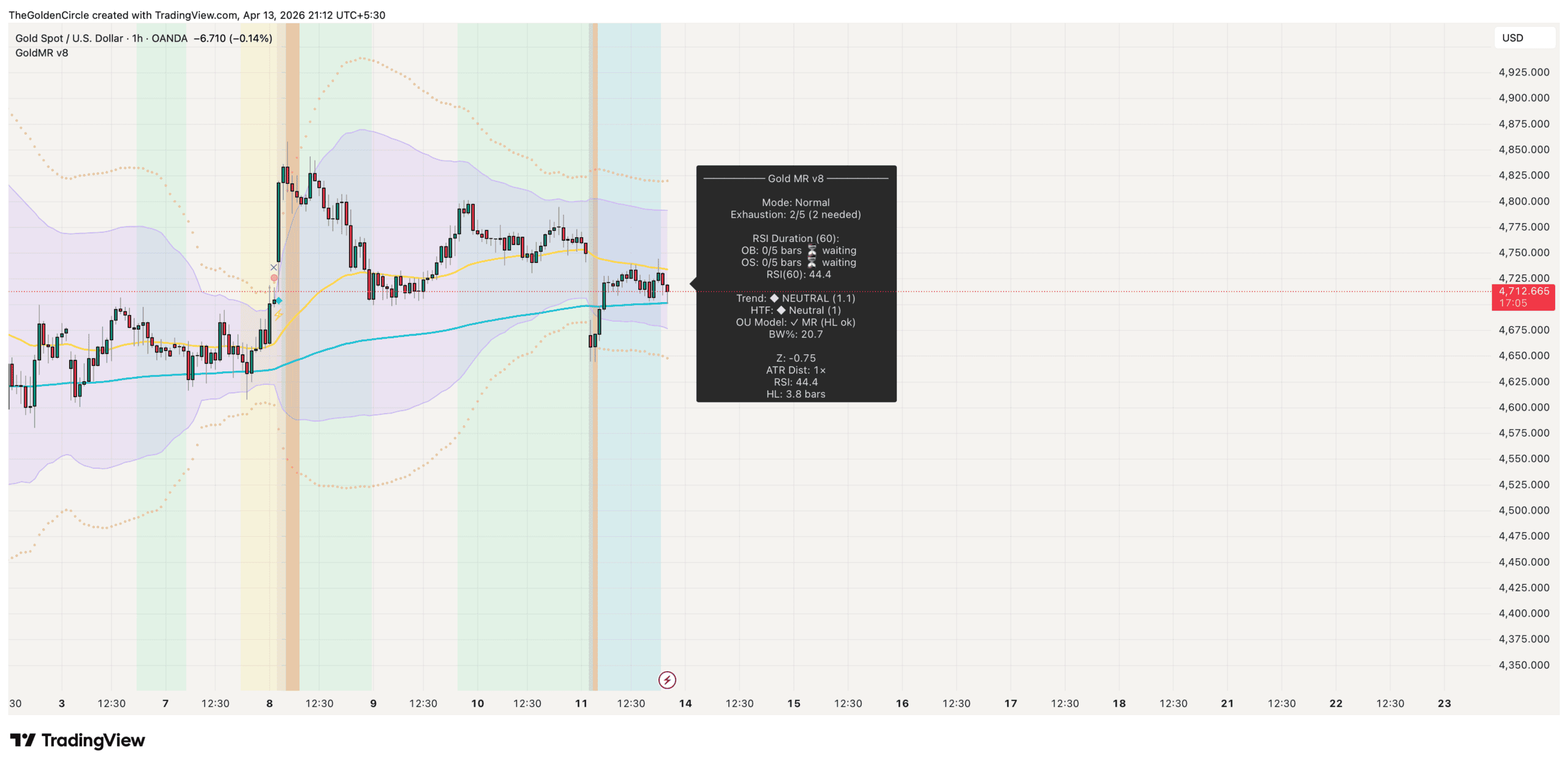
The real-time info panel on your chart shows exactly what the indicator is thinking. No black boxes. Here’s what each field means:
| Field | What It Shows |
|---|---|
| Mode | Current state – Normal, Extreme Zone, or Exhaustion Confirmed |
| Exhaustion | Score out of 5 with individual component checklist |
| RSI Duration | How many bars RSI has stayed in the overbought/oversold zone |
| Trend | Current trend state (Bull/Bear/Neutral) with numerical score |
| HTF | Higher timeframe trend override – is the bigger picture confirming? |
| OU Model | Whether the Ornstein-Uhlenbeck model confirms mean-reverting behavior |
| BW% | Bollinger Bandwidth percentile – detects squeeze conditions |
| Z-Score | Current deviation from mean in standard deviations |
| ATR Dist | Price distance from mean in ATR multiples (backup extreme detection) |
| RSI | Current RSI value |
| Half-Life | Estimated number of bars for half the current deviation to close |
6. The Recommended H1 Swing Trading Workflow
After over 20 iterations of testing, here’s the workflow that produces the most consistent results. I use this myself – it’s not theoretical.
Step 1: Apply the indicator to XAUUSD on the H1 chart. Set your TradingView chart to XAUUSD, 1-Hour timeframe. Add the Gold Mean Reversion v8 from your indicator favorites. All default settings are pre-tuned for Gold H1 – you don’t need to change anything to get started.
Step 2: Read the background color for instant trend context. Green = bullish regime, focus on LONG signals. Red = bearish regime, focus on SHORT signals. Yellow = squeeze, stay out entirely.
Step 3: Wait for the extreme signal for highest conviction. For swing trading, the extreme exhaustion signals are your primary setups. These fire at major tops and bottoms when five independent checks confirm the move is exhausted. You might wait weeks between signals – and that’s fine.
Step 4: Verify the info panel before entering. Check: Is the OU model active? Is the exhaustion score 4/5 or 5/5? Is the Z-Score above 2.5? Is the trend filter confirming? If all boxes check, you have a high-probability trade.
Step 5: Enter on the signal bar, stop beyond the swing extreme. Place your entry on the bar where the signal appears. Stop loss goes beyond the most recent swing high (for shorts) or swing low (for longs). Risk no more than 1-2% of your account per trade.
Step 6: Exit when the indicator says EXIT or Z-Score reverts to zero. The indicator generates Exit signals when the Z-Score returns toward zero – that’s your take-profit zone.
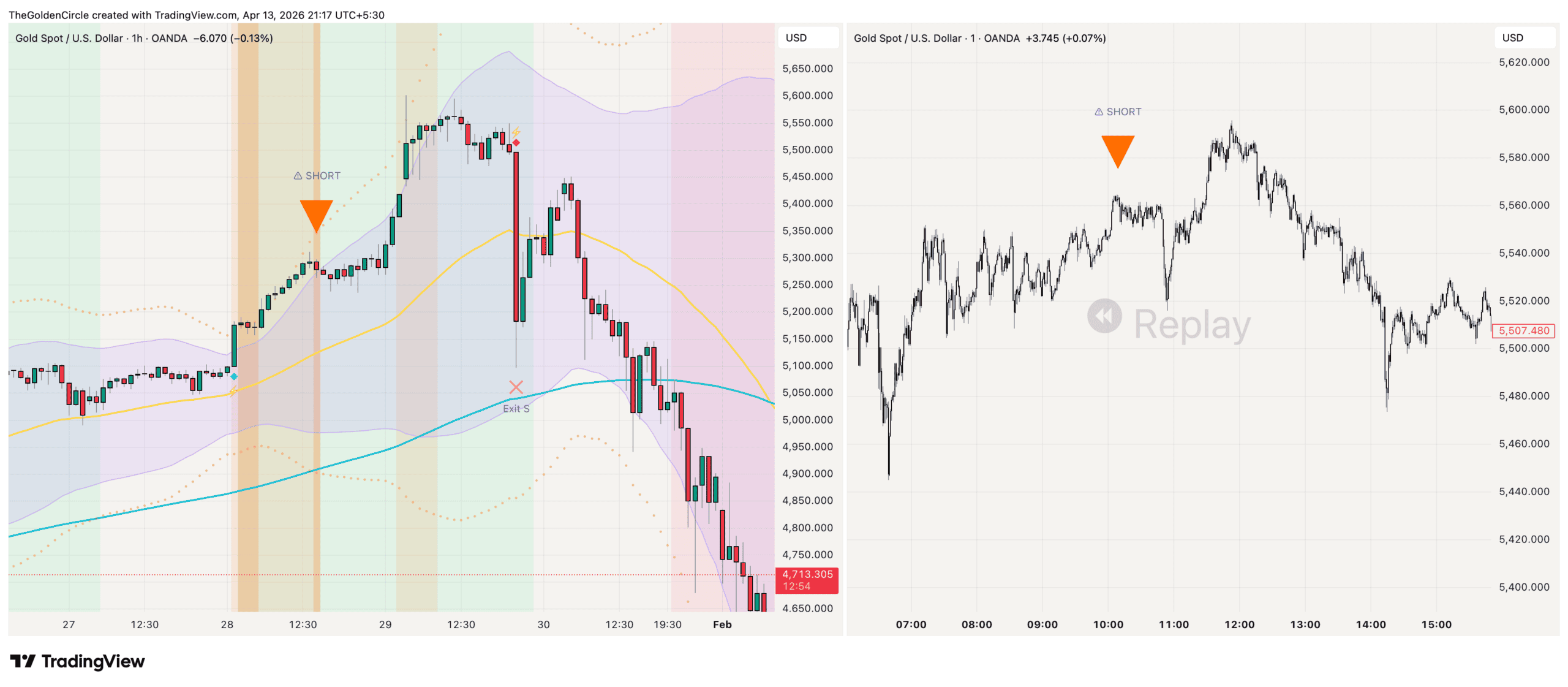
Pro tip from my own trading: I keep a second TradingView tab open with the 1M version of this indicator. When the H1 fires an extreme signal, I switch to the 1M chart for a tighter entry. This multi-timeframe approach regularly gives me entries 50 to 200 points better than the H1 signal bar alone.
7. The Multi-Timeframe Edge: Combining H1 with the 1M Scalper
This is where the Gold Mean Reversion system becomes seriously powerful. The H1 and 1M versions were designed as a pair – same mathematical engine, different calibrations.
H1 tells you WHAT to do. It identifies the reversal zone – the area where Gold is overextended and a mean reversion is statistically likely.
The 1M version tells you WHEN to do it. It pinpoints the exact bar where micro-structure confirms the reversal has begun, giving you a precise entry with a much tighter stop.
Why this matters – a real example
Say the H1 extreme SHORT signal fires at $5,300 while Gold is still pushing higher. If you enter immediately, you’re early. Price might extend to $5,500 before actually turning. That’s 200 points of drawdown you didn’t need.
But if you wait for the 1M SHORT confirmation, you get the signal much closer to the actual top – maybe at $5,480. Your entry is dramatically better, your stop is tighter, and your risk-to-reward ratio improves significantly.
This is the same approach used by institutional trading desks: higher timeframe for direction, lower timeframe for execution.
Related – companion indicator:
Gold 1-Minute Scalping Indicator for XAUUSD – Precision Entries with Mean Reversion
All Asligold TradingView Indicators – Complete Gold Trading Toolkit
8. Key Settings Explained (With Recommended Values)
Every parameter has a tooltip in the indicator explaining what it does and suggesting ranges. But here’s a quick reference for the most important settings:
| Setting | Default (H1) | What It Controls |
|---|---|---|
| Z-Score Entry Threshold | 2.0 | How far from the mean price must deviate before a normal signal can fire. |
| Z-Score Exit | 0.5 | Where the Z-Score must revert to before an Exit signal generates. |
| Extreme Z-Score | 3.0 | Threshold for extreme exhaustion signals. Less than 0.3% probability event. |
| ATR Distance (Extreme) | 5.0 | Backup extreme detection using ATR multiples during sigma expansion. |
| Trend Smoothing | Medium | How responsive the Schmitt trigger trend filter is. |
| HTF Override | 4H | The higher timeframe used to prevent counter-trend signals. |
| RSI Duration | Enabled | Counts bars RSI stays in OB/OS zone. Part of exhaustion scoring. |
| Exhaustion Lookback | 10 bars | How far back the indicator scans for exhaustion patterns (10 hours on H1). |
Don’t over-optimize: The default settings have been tuned through 20+ iterations on live Gold data. I’d recommend trading them as-is for at least a month before making any adjustments. The most common mistake is tightening thresholds to get more signals – this always degrades signal quality. If you want more frequent trades, use the 1M scalper version instead of weakening the H1 filters.
9. Real Trade Examples – Signals That Actually Worked
The indicator flagged this as an extreme exhaustion zone while Gold was still rallying. Z-Score hit 3.0+, all five exhaustion components checked positive, and the trend filter had just shifted to bearish on the higher timeframe. The signal fired – and price reversed hundreds of dollars over the following days.
Notice what didn’t happen: the indicator didn’t fire SHORT signals during the entire rally leading up to this point. The trend filter blocked them because the uptrend was healthy. Only when the statistical conditions reached genuine extremes did the indicator speak up.
Example 2: A perfect LONG trade from a deep pullback
During a healthy uptrend (green background), Gold pulled back sharply. The Z-Score dropped to -2.5, the OU model confirmed mean-reverting behavior, and the trend filter confirmed the broader direction was still bullish. The LONG signal fired at the pullback low. Price snapped back to the mean within a few trading sessions.
Example 3: Squeeze detection – the indicator staying quiet when it should
This is equally important. During this consolidation phase, many indicators would have generated multiple buy and sell signals that all would have been stopped out. The Gold Mean Reversion v8 detected the Bollinger Band squeeze (yellow background), blocked all signals, and waited. Only after the breakout did signals resume – in the correct direction.
10. How to Get Access (Invite Only)
This indicator is invite-only on TradingView. Request access by sending a DM with your TradingView username.
Request Access on Telegram
View on TradingView
Also available: 1M Scalper version | BTC Mean Reversion [H1] | RSI Duration Counter
11. FAQ: 6 Questions Every Gold Trader Asks
1. Does the Gold Mean Reversion indicator repaint signals? ▼
No. All signals are calculated on confirmed closed bars. Once a triangle appears on your chart, it stays. The Z-Score, trend filter, and exhaustion checks all use completed candle data – nothing changes retroactively. The small x markers (blocked signals) are also non-repainting.
2. Why isn’t the indicator giving me LONG signals during a Gold uptrend? ▼
Because this is a mean reversion indicator, not a trend-following tool. In a sustained uptrend, price stays near or above the mean. The Z-Score rarely drops below -2.0 because pullbacks are shallow. The indicator correctly stays quiet – there’s nothing to revert. For buy-the-dip entries during uptrends, use a dedicated trend-following indicator. I have those on my TradingView profile as well.
3. What is the Ornstein-Uhlenbeck process in Gold trading? ▼
The Ornstein-Uhlenbeck process is a mathematical model from quantitative finance that describes how a variable tends to drift back toward a long-term mean over time. Think of it like a rubber band – the further you stretch it, the harder it pulls back. Applied to Gold trading, the model estimates three key parameters: the speed of mean reversion (theta), the equilibrium price level (mu), and the volatility (sigma). It tells you when Gold has deviated so far from fair value that a snapback is statistically likely.
4. How many signals does the H1 indicator generate per month? ▼
On the H1 timeframe, expect 3 to 5 normal signals per month and 2 to 4 extreme exhaustion signals per year. The indicator is deliberately selective – every signal passes through multiple statistical and price-action filters. Quality over quantity is the design philosophy. If you want more frequent signals, use the companion 1M scalper version.
5. Can I use this indicator for assets other than Gold XAUUSD? ▼
The H1 version is specifically optimized for Gold (XAUUSD). The underlying Ornstein-Uhlenbeck model works on any mean-reverting asset, but all the parameters are calibrated specifically for Gold’s volatility profile on the hourly chart. Separate versions with asset-specific tuning are available for BTC/USD and Forex pairs.
6. How do I combine the H1 and 1M versions for better entries? ▼
The recommended multi-timeframe workflow is: Step 1, watch the H1 chart for an extreme signal – this tells you Gold is in a major reversal zone. Step 2, switch to the 1M chart and wait for a normal SHORT or LONG signal – this confirms the reversal on micro-structure. The H1 identifies the zone; the 1M pinpoints the bar. This approach typically improves your entry by 50 to 200 points.
Read next:
Gold 1-Minute Scalping Indicator for XAUUSD – Precision Entries with Mean Reversion
Asligold TradingView Indicators – Complete Gold Trading Toolkit
Best Gold Indicator TradingView 2026: Statistical Arbitrage Engine
Gold Price Prediction – Weekly XAUUSD Analysis
Risk Disclaimer
Trading Gold (XAUUSD) and other financial instruments carries substantial risk. Past performance does not guarantee future results. The Gold Mean Reversion v8 indicator is a decision-support tool for educational and informational purposes only – it is not financial advice. Always use proper risk management, including position sizing and stop-loss orders. Never risk more than you can afford to lose. No indicator is 100% accurate. The final trading decision is always yours. This website contains affiliate links – see full disclaimer.