Bitcoin Trading Strategy TradingView – 4-Strategy BTCUSD H1 Portfolio with Validated 11-Year Backtest
Most Bitcoin trading strategies on TradingView fail outside the market regime they were built in. A pure trend follower gets crushed during 2022-style chop. A mean reversion system gets steamrolled in the 2017 mania. A momentum breakout system whipsaws when volatility dies. The fix is not building a smarter single strategy. The fix is running four uncorrelated systems in parallel, each engineered for a different market condition. This post covers the complete AsliGold BTCUSD H1 portfolio – four production-ready Pine Script strategies plus a unified master signal indicator, all open-sourced on TradingView, all validated across 688,500 backtest configurations and 11+ years of Coinbase data. Combined Calmar ratio of 3.56, daily Sharpe 1.87, 12 of 12 years positive, and a maximum drawdown to total return ratio of 2.5 percent. Here is exactly how each strategy works, why combining them produces institutional-grade metrics no single system achieves, and how to deploy the entire portfolio with a single TradingView alert.
Combined equity curve of all 4 AsliGold BTC H1 strategies, 2015-2026, equal-weight portfolio at 1R per system per trade.
Contents
- Why Single-Strategy Bitcoin Systems Fail
- The Research Pipeline: 688,500 Configurations Tested
- Strategy 1: AG BTC ATR Expansion H1 (Volatility)
- Strategy 2: AG BTC Donchian-55 H1 (Trend)
- Strategy 3: AG BTC Momentum-48 H1 (Momentum)
- Strategy 4: AG BTC RSI-7 MR H1 (Mean Reversion)
- The Portfolio Effect: Why Diversification Multiplies the Edge
- The Master Signal Indicator: All 4 Strategies, One Chart
- Honest Disclosures: What You Need to Know Before Trading
- How to Deploy the Portfolio
- Frequently Asked Questions
Why Single-Strategy Bitcoin Trading Strategy Systems Fail
The graveyard of retail trading is filled with strategies that worked beautifully in backtest and collapsed in live trading. The reason is almost never about execution quality or slippage assumptions. The reason is regime dependency. Bitcoin moves through structurally different market conditions: explosive bull runs, slow grinding bears, multi-month consolidations, volatility expansions, and crisis-driven crashes. A single Bitcoin trading strategy is structurally optimized for one or two of these regimes and underperforms or loses money in the others.
A trend-following Bitcoin trading strategy that captured the 2017 mania (+2,000 percent that year) would have given back most of those gains during the 2018 winter as every breakout failed. A mean-reversion system that worked beautifully during the 2019 consolidation would have been destroyed during the parabolic 2020-2021 bull. A momentum breakout system that fired clean signals during the 2024 ETF rally would have whipsawed continuously through 2022-2023 chop.
The portfolio approach is how institutional traders have always operated. CTA funds run dozens of trend-following systems across hundreds of markets simultaneously. Quant equity funds blend momentum, value, quality, and low-volatility factors. The reason is mathematical: when correlations between strategies are low, combined drawdown is far smaller than any individual strategy’s drawdown, and combined return per unit of risk improves dramatically.
This BTCUSD H1 portfolio applies the same principle to a single market with four strategies, each targeting a distinct edge family.
The Research Pipeline: 688,500 Configurations Tested
The four strategies in this portfolio survived a brutally selective research pipeline. Building a Bitcoin trading strategy on TradingView that works in backtest is easy. Building one that works across multiple uncorrelated regimes for over 11 years requires a different methodology.
| Stage | Method | Survivors |
|---|---|---|
| Stage 1 | Exhaustive Python sweep across 7 method families, 688,500 configurations | ~1,200 |
| Stage 2 | Era stability filter (positive in 8 of 9 historical regimes) | ~85 |
| Stage 3 | Walk-forward validation (5 folds, IS-to-OOS ratio above 0.7) | ~30 |
| Stage 4 | Greedy correlation decorrelation (max pairwise corr 0.50) | ~12 |
| Stage 5 | Pine Script implementation, TradingView validation, R-unit accounting | 4 |
The 9 historical regimes used for stability testing are: Early Bull (2015-2016), Mania (2017), Winter (2018), Recovery (2019-2020 H1), Mega Bull (2020 H2-2021), Bear (2022), Consolidation (2023), ETF Bull (2024), and Post (2025-2026). Each regime is structurally different, and any strategy that fails in even two of them is rejected as not robust.
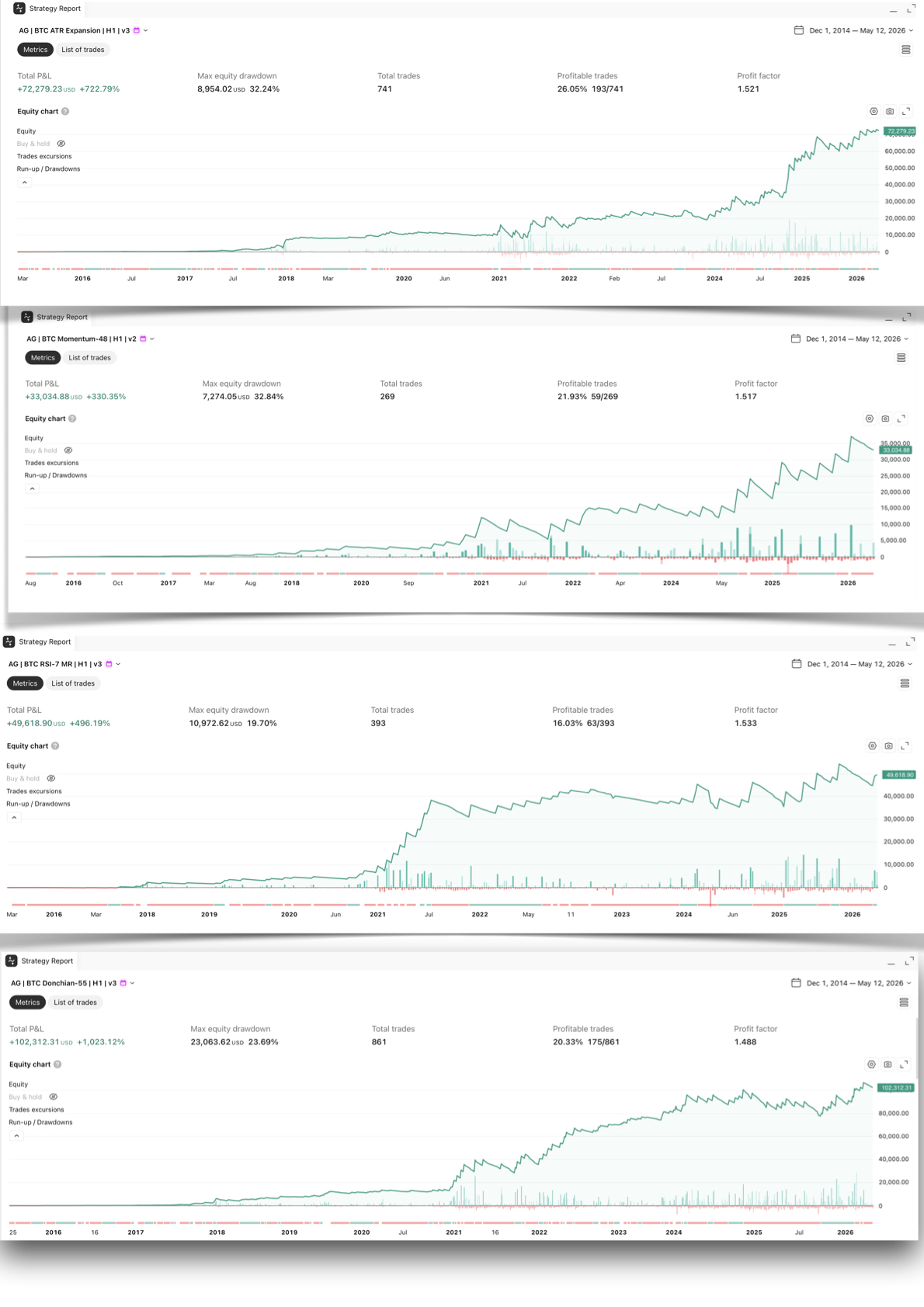
Individual equity curves for the four strategies, 2015 to 2026. Each system tells a different story.
Strategy 1: AG BTC ATR Expansion H1 (Volatility, Long-Only)
The volatility breakout Bitcoin trading strategy on TradingView. This system targets explosive bullish bars in confirmed uptrends – the kind of single-bar moves that signal institutional order flow and tend to be followed by continuation.
The specific setup:
- H1 bar range exceeds 2.5 times the recent 14-bar average range (volatility expansion)
- Bar closes bullish (close above open)
- Price is above H4 EMA-200 (uptrend confirmed)
- Price is at least 1.5 H4 ATR above the H4 EMA-200 (room to run)
When all four conditions align on the same H1 bar, the strategy enters long at the next bar’s open with a 1.0 ATR stop and a 10.0 ATR take profit, with a 48-bar maximum hold time as a safety exit.
| Metric (TV backtest, 2015-2026) | Value |
|---|---|
| Profit Factor | 1.531 |
| Net Profit (on 10k initial capital) | +697.74 percent |
| Total Trades | 739 |
| Win Rate | 26.12 percent |
| Max Drawdown | 32.24 percent |
| CAGR | 20.34 percent |
| 9 of 9 regimes positive | Yes |
Long-only is a deliberate design choice. Bitcoin has a structural long bias on the H1 timeframe, and ATR-expansion shorts (large bearish bars in confirmed downtrends) are a separate edge with different mechanics. Mixing them dilutes both. The ATR Expansion strategy is the cleanest pure-volatility play in the portfolio.
View AG BTC ATR Expansion v3 on TradingView
Strategy 2: AG BTC Donchian-55 H1 (Trend, Bidirectional)
The classic trend-following Bitcoin trading strategy on TradingView, refined for crypto with multi-timeframe filters. The Donchian channel breakout dates back to the 1980s Turtle Traders, who proved that simple range-breakouts are one of the most persistent edges in markets. The reason is structural: range-breakouts force trapped traders to capitulate, providing reliable order flow.
The challenge is that 60-70 percent of pure breakouts fail. The filter combination on this Bitcoin trading strategy was data-mined from the full 688,500-configuration sweep and selected for regime stability rather than maximum backtest profit.
Long entry conditions:
- Close breaks above the prior 55-bar high
- Close above D1 EMA-200 (daily uptrend)
- H4 Bollinger Band width is at or below 0.109 (volatility compression on H4)
- H4 RSI is at or above 52 (momentum confirmation)
Short entry conditions:
- Close breaks below the prior 55-bar low
- Close below D1 EMA-200 (daily downtrend)
The asymmetric filter set (longs require BB compression and RSI confirmation, shorts only require D1 trend) reflects empirical findings: BTC breakdown shorts work cleanly when D1 is bearish, but breakout longs need a tighter coiled-spring setup to survive whipsaws in choppy uptrends.
| Metric (TV backtest, 2015-2026) | Value |
|---|---|
| Profit Factor | 1.496 |
| Net Profit | +1,035 percent |
| Total Trades | 859 |
| Win Rate | 20.37 percent |
| Max Drawdown | 23.69 percent |
| CAGR | 23.66 percent |
| 9 of 9 regimes positive | Yes |
The 23.69 percent maximum drawdown is the lowest of the four AsliGold BTC strategies and the highest CAGR, making this the most well-rounded individual system in the portfolio.
View AG BTC Donchian-55 v3 on TradingView
Strategy 3: AG BTC Momentum-48 H1 (Momentum, Bidirectional)
The most selective Bitcoin trading strategy on TradingView in the portfolio. This system measures 48-bar return (close versus close 48 bars ago) and triggers only when this measure crosses thresholds with multi-filter confirmation. Result: only 269 trades over 11+ years. Roughly 25 signals per year.
Long entry needs ALL of:
- 48-bar return crosses above +3.5 percent (momentum threshold breach)
- Close above D1 EMA-200
- Price at least 4 D1 ATR above D1 EMA-200 (strong extension)
- H4 RSI is at or above 56
- H4 Bollinger Band width is at or below 0.083
Short entry mirrored:
- 48-bar return crosses below -3.5 percent
- Below D1 EMA-200
- Price at least 4 D1 ATR below D1 EMA-200
- H4 RSI at or below 41
- H4 BB width at or below 0.07
The 4 D1 ATR distance filter is the most important component. It prevents the strategy from chasing late-stage moves that have already exhausted their fuel. Combined with H4 BB compression (a coiled-spring volatility setup) and H4 RSI alignment, the strategy enters momentum bursts that have structural room to extend.
| Metric (TV backtest, 2015-2026) | Value |
|---|---|
| Profit Factor | 1.517 |
| Net Profit | +330 percent |
| Total Trades | 269 |
| Win Rate | 21.93 percent |
| Max Drawdown | 32.84 percent |
| CAGR | 13.61 percent |
| 9 of 9 regimes positive | Yes |
View AG BTC Momentum-48 v2 on TradingView
Strategy 4: AG BTC RSI-7 MR H1 (Mean Reversion, Bidirectional)
The orthogonal companion to the trend systems. When trends fail (consolidation, range-bound markets), mean reversion shines. RSI-7 is intentionally fast – standard RSI-14 smooths too much for short-term reversal capture. The 7-period setting catches sharper extremes that produce cleaner bounces and fades.
Long entry:
- RSI(7) crosses above 30 from below (oversold bounce)
- Close above H4 EMA-200 (uptrend confirmed)
- ATR/Close ratio between 0.7 and 1.5 percent (volatility regime sweet spot)
- D1 ADX outside the 23-35 range (avoid mid-trend chop zone)
Short entry mirrored:
- RSI(7) crosses below 70 from above
- Close below H4 EMA-200
- Same volatility and ADX filters
The volatility filter (ATR/Close 0.7-1.5 percent) was derived empirically from bucket analysis of 1,200+ trades. The D1 ADX chop filter was added in v3 after diagnostics showed that 2023-2025 underperformance traced to mid-trend D1 conditions where neither trend nor reversal worked.
The 0.7 ATR stop is intentionally tight because RSI reversal failures move fast. When mean reversion is wrong, it is usually wrong immediately. Wider stops on this signal type tend to convert small losses into large ones without improving win rate.
| Metric (TV backtest, 2015-2026) | Value |
|---|---|
| Profit Factor | 1.533 |
| Net Profit | +496.19 percent |
| Total Trades | 393 |
| Win Rate | 16.03 percent |
| Max Drawdown | 19.70 percent (LOWEST in portfolio) |
| Out-of-Sample R per trade ratio | 1.30 (better than IS) |
The OOS R per trade ratio of 1.30 is unusually strong. It means the strategy actually performs better in out-of-sample data (2021-2026) than in the in-sample period (2015-2020). This is the opposite of overfitting.
View AG BTC RSI-7 MR v3 on TradingView
The Portfolio Effect: Why Diversification Multiplies the Edge
Individual strategies are good. Combined, they become institutional-grade. This is not marketing language. It is what the math shows when four uncorrelated edges run in parallel.
| Daily Return Correlation | S1 ATR | S2 Donch | S3 Mom | S4 RSI |
|---|---|---|---|---|
| S1 ATR | 1.00 | 0.33 | 0.19 | 0.02 |
| S2 Donchian | 0.33 | 1.00 | 0.31 | -0.02 |
| S3 Momentum | 0.19 | 0.31 | 1.00 | 0.03 |
| S4 RSI MR | 0.02 | -0.02 | 0.03 | 1.00 |
The mean reversion system (S4) has correlation below 0.05 with everything else. This is real diversification, not the fake kind where everything moves together in a crisis.
Combined Bitcoin trading strategy portfolio metrics (equal-weight, 11 years, R-units):
| Portfolio Metric | Value | Industry Benchmark |
|---|---|---|
| Total Return (R-units) | +1,829R | N/A |
| Annualized Return | +161 R/year | N/A |
| Max Drawdown | 45R | N/A |
| Drawdown to Return Ratio | 2.5 percent | 10-20 percent typical |
| Calmar Ratio | 3.56 | Above 1.0 = good, above 3.0 = exceptional |
| Daily Sharpe Ratio | 1.87 | Above 1.0 = good, above 1.5 = elite |
| Years Positive | 12 of 12 | N/A |
| Regimes Positive | 9 of 9 | N/A |
A Calmar ratio of 3.56 means the portfolio earns 3.56 times its maximum drawdown per year on average. For comparison, most professionally-managed CTA hedge funds operate with Calmar ratios between 0.5 and 1.5. A daily Sharpe ratio of 1.87 puts this portfolio in the top decile of systematic strategies across all asset classes.
Combined portfolio equity curve. Smooth, diversified, and nearly straight upward. This is what uncorrelated diversification looks like.
The Master Signal Indicator: All 4 Strategies, One Chart
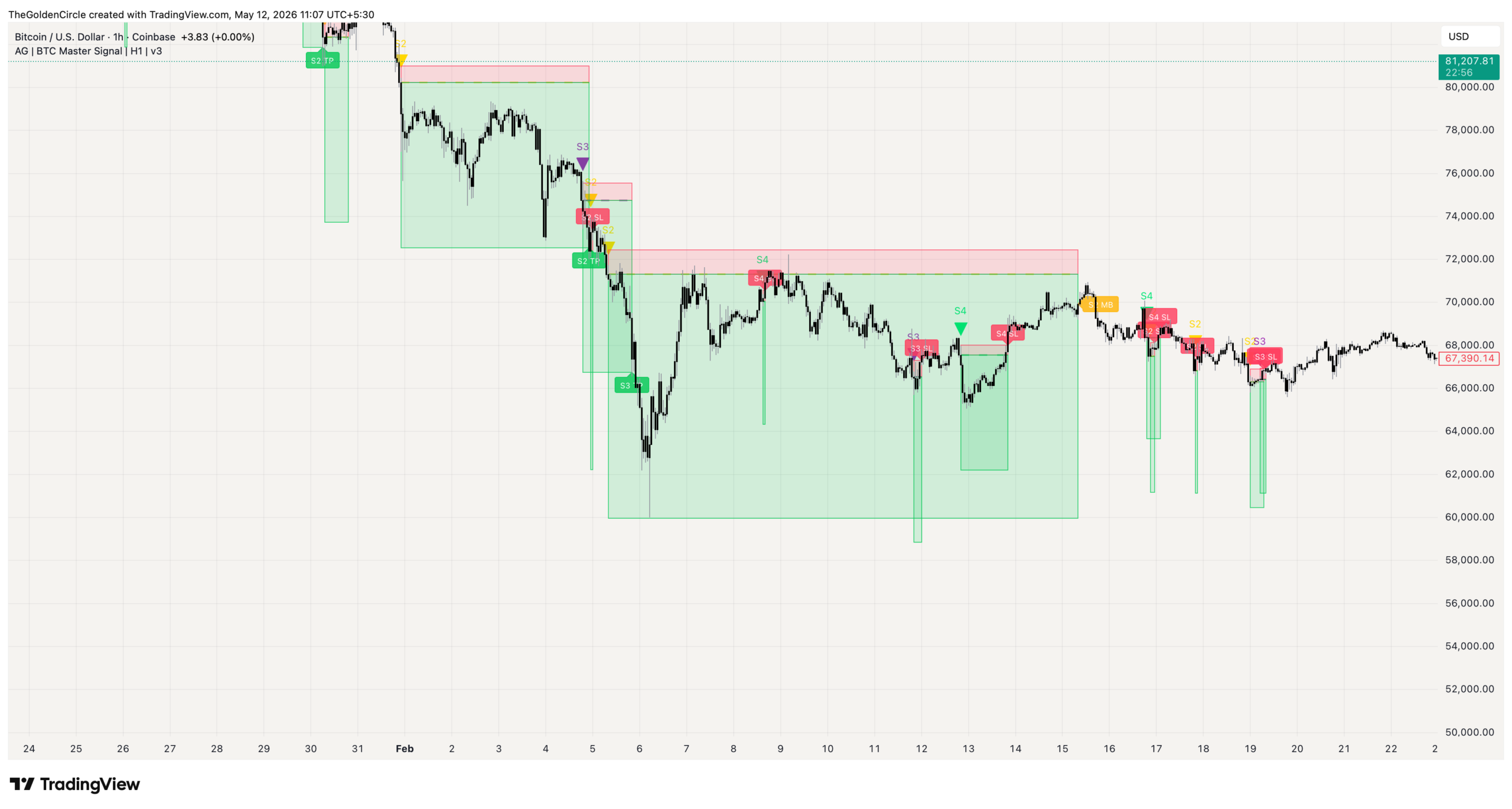
Running four Bitcoin trading strategy systems in parallel manually would mean monitoring four separate scripts on four separate charts. That is operationally unworkable. The AG BTC Master Signal Indicator solves this by tracking all four strategies simultaneously on a single chart with independent virtual position tracking, color-coded entry markers, filled risk and reward zones, and labeled exit markers showing which strategy exited and how.
What you see on the chart:
| Visual Element | Meaning |
|---|---|
| Cyan triangle (S1) | ATR Expansion entry (long-only) |
| Gold triangle (S2) | Donchian-55 entry (long or short) |
| Purple triangle (S3) | Momentum-48 entry (long or short) |
| Green triangle (S4) | RSI-7 MR entry (long or short) |
| Red shaded box | Risk zone (entry to stop loss) |
| Green shaded box | Reward zone (entry to take profit) |
| Labeled exit (“S1 SL”, “S2 TP”, “S4 MB”) | Strategy + exit type at exit price |
| Status label (top corner) | Live state of all 4 strategies |
Alert system: The indicator includes 30 alertcondition entries plus 15 alert() function calls. The “Any alert() function call” option in TradingView’s alert dialog means a single alert covers the entire portfolio. Every signal-forming event, every entry filled, every exit triggered, all routed through one alert with dynamic message content. Even on TradingView’s free plan (1 active alert), this single alert handles the full 4-strategy portfolio.
View AG BTC Master Signal Indicator on TradingView
Honest Disclosures: What You Need to Know Before Trading
This Bitcoin trading strategy portfolio is designed to be deployed by traders who understand the structural realities of low-win-rate, high-reward-to-risk systems. If those realities do not match your psychology, you will not make money with these strategies regardless of how good the math looks on paper.
Win rates are low. S1 ATR Expansion has 26 percent win rate. S2 Donchian-55 has 20 percent. S3 Momentum-48 has 22 percent. S4 RSI MR has 16 percent. These are the lowest individual win rates in the AsliGold catalog, and that is by design. With 8:1 to 10:1 reward-to-risk ratios, the math works through asymmetry, not frequency.
Drawdowns will feel longer than they look. The historical maximum consecutive losing trades for S4 is 38. That can stretch over 2-3 weeks of live trading. Subscribers must have psychological tolerance for grinding losing streaks while waiting for the next runner.
Lottery profile. For most of these strategies, the top 5 percent of trades historically produced more than the entire net profit. Remove the top 5 percent and the strategies are near breakeven. This is structural for asymmetric systems and is not a flaw, but subscribers must understand that returns are concentrated in tail events.
Live trading haircut. TradingView backtests assume perfect fills at limit prices. Live execution has slippage, fees, and exchange-specific quirks. Expect 10-20 percent reduction in profit factor in live trading versus backtest. The 10:1 reward-to-risk structure absorbs this haircut better than tighter reward-to-risk systems would, but it is still real.
Position sizing matters more than the strategies themselves. A common error is sizing trades for the maximum win rather than the typical drawdown. Use ATR-based risk sizing of 0.5 to 1.0 percent per ATR per strategy, which means total portfolio risk per setup is 2-4 percent of equity if all four strategies fire simultaneously (rare). This sizing keeps drawdowns proportional to account size and prevents catastrophic losses.
90-day paper trading rule. Before deploying any of these strategies with live capital, paper trade them for at least 90 days. Validate that your execution matches the indicator signals. Validate that your psychology can handle 30+ trade losing streaks. Validate that your broker actually fills orders at the prices the indicator displays.
How to Deploy the Portfolio
Step 1: Add all 4 Bitcoin trading strategy scripts to your TradingView favorites. Open each link, click the star icon to favorite. This makes them easy to load on any chart.
Step 2: Add the Master Signal Indicator to a BTCUSD H1 chart. Use COINBASE:BTCUSD as the symbol since the strategies were validated on Coinbase data. The indicator will display all four systems simultaneously.
Step 3: Configure one TradingView alert with “Any alert() function call”. This single alert handles the entire portfolio’s notifications. Choose your notification method (mobile push, webhook, email).
Step 4: Paper trade the Bitcoin trading strategy portfolio for 90 days. Track every signal manually in a spreadsheet. Note the entry price, SL, TP, and final result. Compare to the indicator’s claims. Validate execution before deploying capital.
Step 5: Deploy with conservative sizing. Start at 0.5 percent risk per trade per strategy. After 6 months of live trading, scale to 1 percent per trade if results match expectations.
Step 6: Review quarterly. Track your live profit factor versus the backtest. If your live PF is below 70 percent of backtest PF after 50+ trades, your execution has issues that need diagnosis.
Ready to deploy the portfolio?
All 4 strategies plus the master indicator are free and open-source on TradingView. Start with the master indicator to see all four systems at once.
Frequently Asked Questions
Is this Bitcoin trading strategy free on TradingView?
Yes. All four strategies and the master signal indicator are open-source and free on TradingView. No subscription, no invite-only access, no premium tier. The Pine Script code is public and readable for anyone who wants to study or modify it.
What timeframe does this Bitcoin trading strategy portfolio work on?
All four strategies are designed and validated specifically for the H1 (1-hour) timeframe on BTCUSD. Higher-timeframe filters reference H4 and D1 data internally. Running these strategies on other timeframes will produce different results because the parameters were optimized for H1 specifically.
Can I run this Bitcoin trading strategy on Binance or Bybit instead of Coinbase?
Yes, but the validation was done on COINBASE:BTCUSD specifically. Different exchanges have different microstructure, gap behavior, and liquidity patterns. Expect minor variation in results. The strategy logic is exchange-agnostic, but live execution should be tested on your specific venue before scaling capital.
Does the Bitcoin trading strategy work on altcoins or only BTCUSD?
The strategies are validated only on BTCUSD H1. They are likely to work directionally on ETH and other major altcoins because the structural edges (volatility, trend, momentum, mean reversion) are general phenomena, but parameters would need re-optimization for each asset. Do not assume the same metrics apply to altcoins without independent validation.
How much capital do I need to deploy this Bitcoin trading strategy properly?
The minimum recommended capital is enough to size 1 percent of equity per ATR with at least 50 trades of buffer. For BTCUSD H1 where typical ATR is 0.5-1.5 percent of price, this works out to roughly 5,000 USD minimum. Below this, position sizing rounds to whole units that cause too much variance per trade.
Can I disable some strategies and only run others?
Yes, the master indicator has individual toggles for each strategy. However, doing so weakens the portfolio. The diversification benefit comes specifically from running all four together. Disabling the mean reversion strategy in particular removes the most uncorrelated component and increases combined drawdown.
Why is the win rate so low?
All four strategies use 8:1 to 10:1 reward-to-risk ratios with wide take profits. This is structural. Wide TPs mean fewer trades complete in profit, but the ones that do are large multiples of the risk. The math works through asymmetry. A 16 percent win rate at 8:1 RR has the same expected value as a 80 percent win rate at 0.25:1 RR, but the asymmetric version is far more robust to slippage and parameter drift.
Risk Disclaimer: This content is for educational purposes only and does not constitute financial advice. Past performance shown in backtests does not guarantee future results. Cryptocurrency trading involves substantial risk of loss. The author publishes systematic strategies as research and educational tools, not as recommendations to trade with capital. Always paper trade new systems for at least 90 days before deploying real capital, and never trade with money you cannot afford to lose. See full disclaimer.