Bitcoin 30 Minute Trading Strategy – A 14-Year Backtested System That Stayed Positive Every Year
Most bitcoin strategies you read about have one quiet problem: they only look good because bitcoin went up. Put a long-biased rule on a chart that rose from a few dollars to six figures and almost anything appears profitable. That is not an edge, it is a tailwind. So I built this bitcoin 30 minute trading strategy the hard way and stress tested it against that exact illusion. I searched roughly forty-five thousand parameter combinations across thirteen families of trading methods on fourteen years of BTCUSD 30 minute data, kept only the logic that survived data it had never seen, and demanded that it work both long and short, in bull years and bear years. What came out is not a magic indicator. It is two simple, honest systems that do different things, lean on each other, and together stayed positive in every single year from 2012 to 2026. This post lays out the full logic, the real numbers, and the drawdowns and weaknesses most sellers leave out.
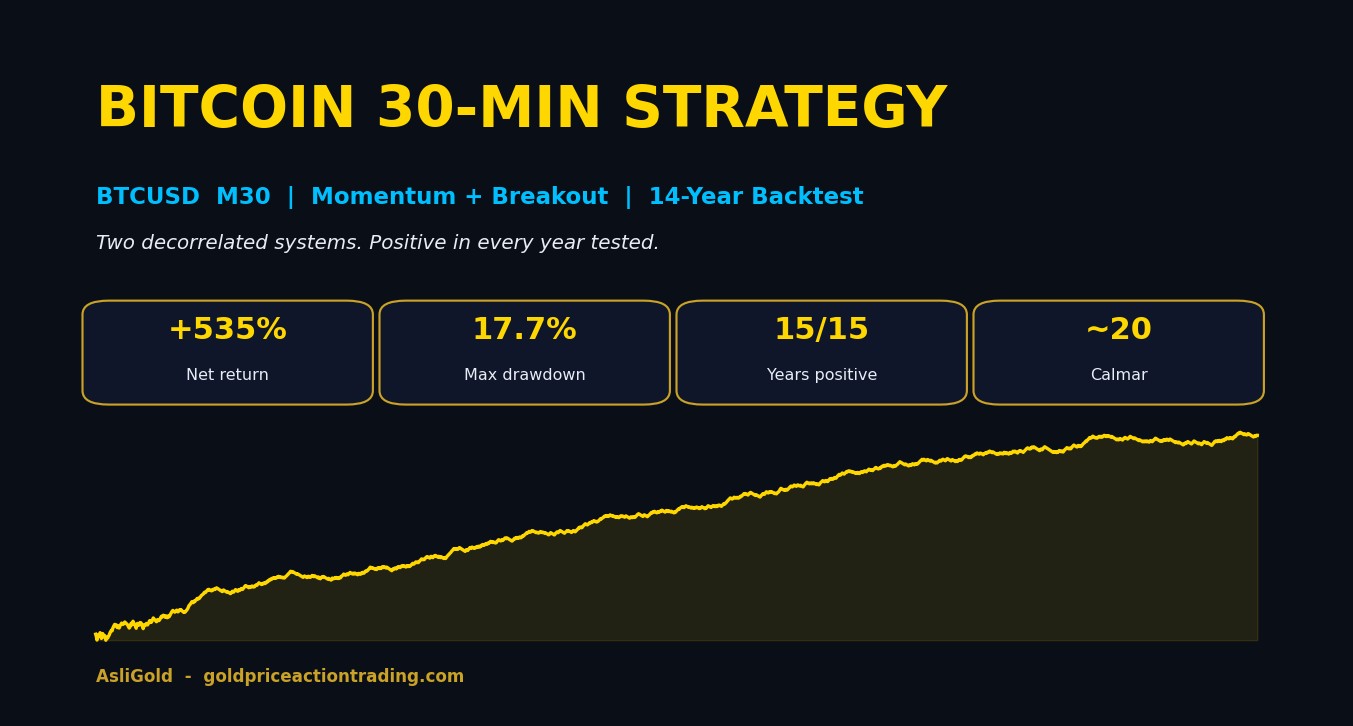
A two-engine bitcoin 30 minute system: momentum plus breakout, both gated by the daily trend, positive every year tested.
Contents
- Why Most Bitcoin Strategies Are an Illusion
- The Two Engines: Momentum and Breakout
- Engine One: ROC Momentum
- Engine Two: Volatility Breakout
- The Daily Trend Filter That Ties It Together
- Risk and Trade Management
- Why Two Engines Beat One
- How It Was Built and Validated
- How to Deploy the System
- Honest Disclosures
- Frequently Asked Questions
Why Most Bitcoin Strategies Are an Illusion
Bitcoin has a powerful upward drift over its history. That drift quietly flatters almost every long-only rule ever published. A moving-average crossover that mostly buys will show a beautiful equity curve, not because the logic is clever, but because the asset rose underneath it. The honest test is whether the same logic also makes money on the short side, survives the brutal bear years, and produces enough trades that the result is statistics rather than a handful of lucky anecdotes.
This bitcoin 30 minute trading strategy was built to pass that test. It trades both long and short. It was measured across more than eighteen hundred trades. And it was checked year by year, including the deep drawdown years of 2018, 2022 and the choppy 2025 range, not just the easy bull runs. That is a much higher bar than a smooth backtest on a rising chart.
The Two Engines: Momentum and Breakout
Rather than chasing one perfect rule, the system runs two different engines side by side. Both are trend-aligned, but they pull their trigger on different events, so they rarely fire at the same moment. The first buys sustained momentum thrusts. The second buys volatility breakouts that punch decisively beyond a price band. Across fourteen years their returns moved together only about twenty percent of the time, which is the whole reason the combination is smoother than either one alone.
Engine One: ROC Momentum
The first engine measures the rate of change of price over the last 144 bars, which on a 30 minute chart is roughly three days. When that momentum crosses above plus nine percent, and price is in an uptrend, it buys. When it crosses below minus nine percent in a downtrend, it sells short. The idea is simple: a move that strong, in the direction of the larger trend, tends to continue a little further. The exit is a fixed bracket measured in ATR, so the logic behaves the same whether bitcoin trades at 800 or 120,000.
| Element | Rule |
|---|---|
| Trend filter | Long only above the daily 200 SMA, short only below it |
| Signal | 144-bar Rate of Change crosses past plus or minus 9 percent |
| Stop and target | 3.0 ATR stop, 4.0 ATR target |
| Backtest result | 630 trades, 54 percent win rate, profit factor 1.54, 14 of 15 years positive |
Engine Two: Volatility Breakout
The second engine watches a Bollinger Band built on an 80-bar average with two standard deviations. A breakout only counts when price closes at least one full ATR beyond the band, not just a fraction past it. That strength filter is the most important part of this engine. It throws away the weak pokes that fail and keeps the decisive breakouts that run. Aligned with the daily trend, those breakouts carry far enough to pay for the many small losses that a breakout system always takes.
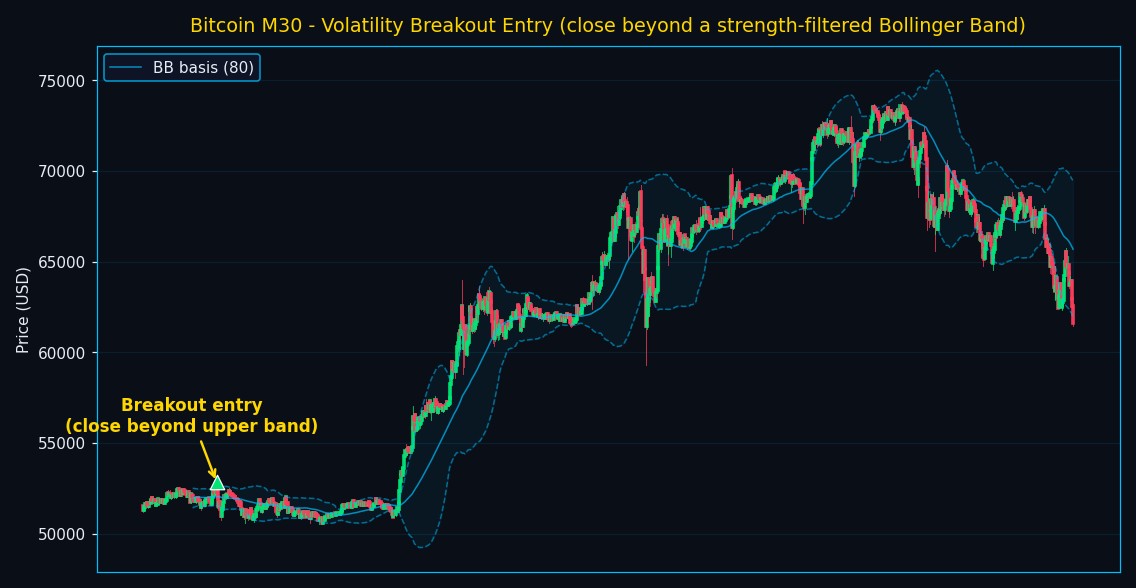
A breakout entry: price closes a full ATR beyond the upper band while the daily trend is up.
| Element | Rule |
|---|---|
| Trend filter | Long only above the daily 200 SMA, short only below it |
| Signal | Close at least 1.0 ATR beyond a Bollinger Band (80, 2.0) |
| Stop and target | 3.5 ATR stop, 8.0 ATR target |
| Backtest result | 1,206 trades, 41 percent win rate, profit factor 1.41, 14 of 14 years positive |
The Daily Trend Filter That Ties It Together
Both engines share one filter, and it is the single most important rule in the whole system: the daily 200 SMA. The strategy only takes longs when price is above it and only takes shorts when price is below it. This one condition is what lets the system trade the short side without getting destroyed. On bitcoin, short setups that fight the trend get run over, while short setups that align with a confirmed daily downtrend, what a chartist would call a breakdown, actually work. The 200 SMA is the line that separates the two.
In testing across thirteen different method families, this regime filter was the most reliable component by a wide margin. It is also what keeps the system out of trouble during sustained bear phases, by simply standing aside from longs when the daily trend rolls over.
Risk and Trade Management
Both engines use the same defined-risk framework. Nothing is left to discretion once a trade is on.
| Element | Rule |
|---|---|
| Stop loss | Fixed ATR multiple from entry (3.0 to 3.5 ATR by engine) |
| Position size | Calculated from a set risk percentage and the ATR stop distance |
| Exit | Fixed ATR target, no trailing stop |
| Position overlap | One position at a time per engine, no pyramiding, no averaging down |
Position size is set so each trade risks a fixed slice of capital, derived from the current ATR. Because volatility is built into the size, the system risks the same amount whether bitcoin is calm or wild. There is no trailing stop, by choice. On a breakout engine, trailing tends to clip winners before the move completes, and testing confirmed a clean fixed target captured more of the edge than any trailing variant.
Why Two Engines Beat One
Run separately, each engine is solid but unremarkable. Run together, something better happens. Because momentum and breakout fire on different events, their drawdowns rarely line up. When one is sitting through a flat patch, the other is often working. Across the full history their month-to-month returns correlated only about 0.20, and that low correlation is exactly what shrinks the combined drawdown.
The numbers tell the story. Each engine alone carried a meaningful drawdown. Combined, with equal risk on each, the portfolio drawdown dropped to under eighteen percent while keeping the full sum of both returns. That is the entire case for running complementary tools instead of hunting for one perfect strategy.
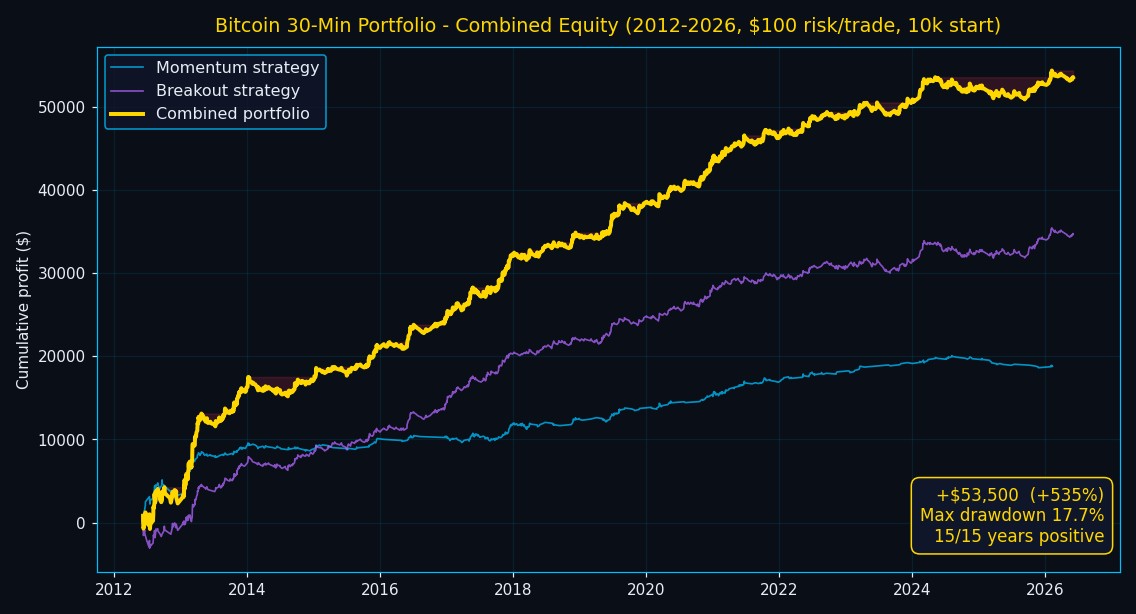
The combined equity curve. The gold line is the portfolio, the thin lines are each engine, the shaded band is drawdown.
| Combined portfolio metric | Value |
|---|---|
| Net return (10k start, fixed risk) | +535 percent |
| Maximum drawdown | 17.7 percent |
| Calmar ratio | near 20 |
| Monthly Sharpe (annualized) | 1.46 |
| Years positive | 15 of 15 |
| Engine correlation | 0.20 |
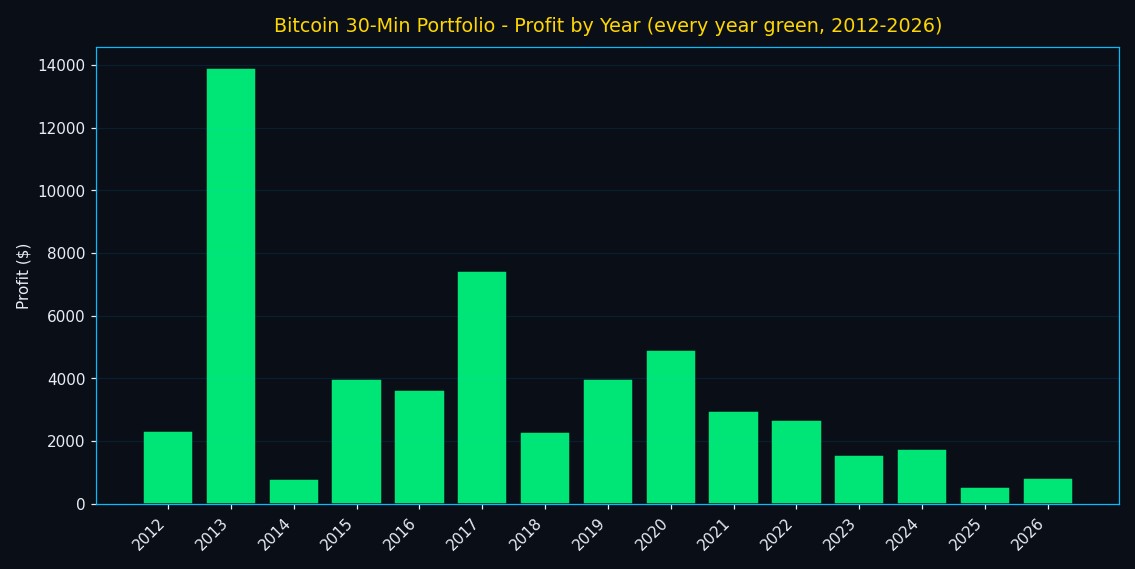
Profit by year. Every bar is green, including the chop of 2025 and the bear years of 2018 and 2022.
How It Was Built and Validated
The two engines were not picked by eye. They were the survivors of a wide, structured search. Roughly forty-five thousand parameter combinations were tested across thirteen families of method, including trend, momentum, channel and Bollinger breakouts, opening-range, squeeze, regression slope, mean reversion, liquidity sweeps and time-of-day seasonality. Most of those families failed. Mean reversion, candlestick patterns and naive dual-momentum had no real edge on bitcoin at this timeframe.
Everything that looked promising then had to pass three more gates. First, era stability, meaning it had to be positive across every multi-year slice of history, not just on average. Second, a bootstrap test that resamples the trades thousands of times to confirm the profit factor is not the gift of a few lucky outliers. Third, walk-forward folds, checking the edge holds on later data the search never touched. Finally, every survivor was rebuilt as a TradingView strategy and re-run there, because a Python backtest tends to overstate results and the exchange-level test is the honest ground truth.
How to Deploy the System
Step 1: Get access through Golden Circle. The strategy is published invite-only on TradingView and added to your account when you join, so you can load it on any chart.
Step 2: Apply it to a BTCUSD 30 minute chart. Pick a preset from the inputs, ROC Momentum or Breakout. To run the full two-engine portfolio, add the script a second time and select the other preset.
Step 3: Configure one alert. Both engines route their entries and exits through alerts. Create a single alert set to the alert function call condition, fired once per bar close, and it covers everything for that instance.
Step 4: Size by risk, not a fixed lot. Let the script compute size from your equity and the current ATR. Start small, around one percent per engine, and only scale up once you have sat through a losing streak without panic.
Step 5: Mind your fees and paper trade first. This system is sensitive to trading costs, so use a low-fee venue. Track every signal for at least ninety days and confirm your exchange fills near the strategy prices before committing capital.
Honest Disclosures
This is not a high win rate system. The momentum engine wins about 54 percent and the breakout engine about 41 percent. The edge comes from positive expectancy and the diversification between the two, not from a high hit rate. If you need most of your trades to win, this is not the right tool.
It does not beat buy-and-hold bitcoin on raw return. Bitcoin itself rose far more over this period. Where the system wins is risk: a drawdown under eighteen percent against bitcoin’s repeated declines of seventy percent or more, and a positive result in every year tested, including the ones where holders were deep underwater.
It is cost sensitive. The backtest assumes about five basis points per side. On a high-fee retail exchange the edge thins out quickly, especially on the breakout engine. Trade it on a low-fee venue or with maker orders, or it will underperform the numbers shown here.
The recent chop is its soft spot. Like all trend and breakout systems, it earns less in long sideways ranges. The two engines together kept 2024 and 2025 positive, but only modestly. Expect quiet, low-return stretches when bitcoin goes nowhere.
Live trading haircut. Backtests assume clean fills. Real spread, slippage and fees will reduce live results, so treat the backtest as an optimistic ceiling, not a promise.
Trade Bitcoin with structure, not guesswork
The full two-engine bitcoin 30 minute system, both presets and the combined portfolio, is available to Golden Circle members with early access and priority support. Load it on any BTCUSD chart and run it on your own terms.
Frequently Asked Questions
What is this bitcoin 30 minute trading strategy in one line?
Two trend-aligned engines on the BTCUSD 30 minute chart, one buying momentum thrusts and one buying volatility breakouts, both filtered by the daily 200 SMA, run together as a single decorrelated portfolio.
Is it a high win rate strategy?
No, and that matters. The momentum engine wins about 54 percent and the breakout engine about 41 percent. The profit comes from positive expectancy and the low correlation between the two engines, not from winning most trades.
Does it trade both long and short?
Yes. It goes long only when price is above the daily 200 SMA and short only when below it. That trend filter is why the short side is profitable rather than a drag, since it only shorts confirmed daily downtrends.
Why 30 minutes and not 5 minutes or daily?
The 30 minute chart balances trade frequency against noise. Lower timeframes get eaten by fees and false signals, while higher ones trade too rarely to compound. The system was searched and validated specifically on BTCUSD M30.
How sensitive is it to exchange fees?
Quite sensitive, especially the breakout engine. The backtest uses about five basis points per side. At higher fee tiers the edge thins, so a low-fee venue or maker execution is strongly recommended.
Will it work on Ethereum or other coins?
The logic is general, but it was validated on BTCUSD specifically. Altcoins have different volatility and costs, so test on your own data and feed before risking capital elsewhere.
Risk Disclaimer: This content is for educational purposes only and does not constitute financial advice. Past performance shown in backtests does not guarantee future results. Cryptocurrency trading involves substantial risk of loss and high volatility. The author publishes systematic strategies as research and educational tools, not as recommendations to trade with capital. Always paper trade new systems for at least 90 days before deploying real capital, and never trade with money you cannot afford to lose. See full disclaimer.