High Win Rate Gold Strategy – A 71% XAUUSD H1 Liquidity Sweep System Built on RSI and Trend
Every trader wants a high win rate, and almost every “high win rate” system you are sold is a wide-stop trap that gives it all back in one bad week. So I did the slow, expensive work instead of guessing. I searched over a million parameter combinations on twenty years of XAUUSD hourly data, ranked them on whether they survived data they had never seen, and kept only what held up. What came out is a high win rate gold strategy that wins about seven trades in ten, not by luck, but because it only fires when a liquidity sweep, momentum exhaustion, and the dominant trend all agree. This post breaks down the full logic, the three setups that make up the system, and the honest numbers, including the drawdown and the worst losing streak that most sellers hide.
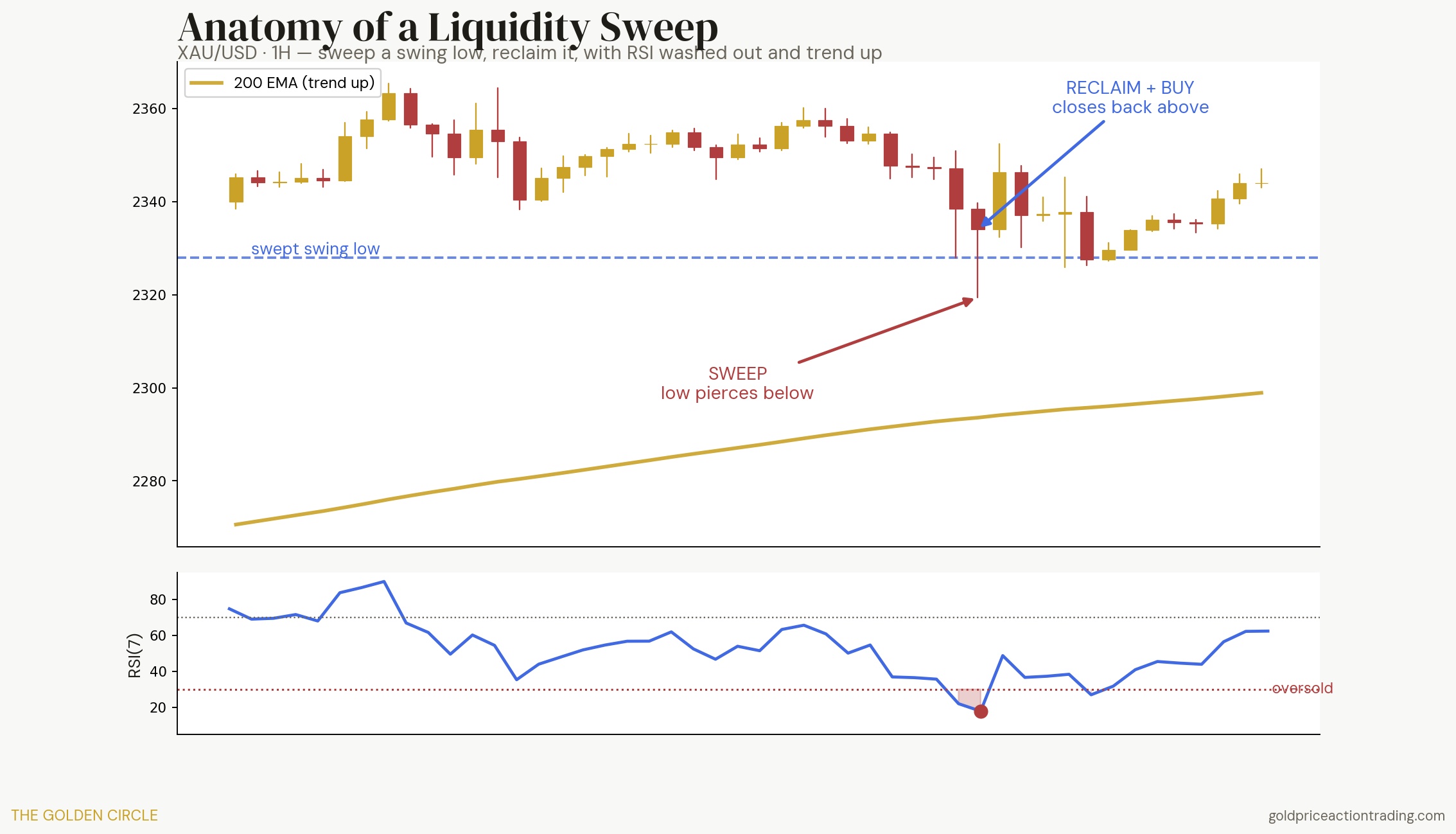
A high win rate gold setup: price sweeps a recent swing low, closes back above it with RSI oversold, while the trend stays up.
Contents
What Makes a High Win Rate Gold Strategy
A high win rate comes from selectivity, not from a magic indicator. If you take every signal, you get the market’s base hit rate, which is close to a coin flip after costs. If you wait for several independent conditions to line up at once, you take far fewer trades, but a much larger share of them work. This high win rate gold strategy is built entirely around that idea. It does nothing most of the time. It only acts when a stop run, washed-out momentum, and the larger trend all point the same way.
The trade-off is honesty about frequency. A selective system trades less. That is the price of a clean win rate, and it is a price worth paying, because the alternative, a busy system with a coin-flip edge, bleeds you through costs and noise.
The Core Edge: Sweep, Reclaim, Trend
Below every recent swing low sits a pool of stop orders. Price often dips just under that low, triggers those stops, then snaps back above. That dip-and-reclaim is a liquidity sweep, the footprint of larger orders being filled against retail stops. The edge is not the sweep itself. The edge is buying the reclaim that follows, and only in the direction of the trend.
That last condition is what separates this from the average sweep system. Fighting the trend, the same setup gets you run over. Aligned with the trend, the swept low becomes a launch pad. The strategy enforces this with a 200-period EMA filter: it only buys when price is trading above it. Add a momentum filter, RSI, to confirm the move is genuinely exhausted rather than mid-trend, and you have the full edge.
The Anatomy of a Valid Entry
A valid entry in this system has four parts. Remove any one and the win rate falls, which is exactly why all four are required on the same closed H1 candle.
1. The trend. Price must be trading above the 200-EMA. This single filter is the system’s bear-market defence; it stands the strategy aside during sustained downtrends.
2. The sweep. The bar’s low must pierce below a recent swing low, running the stops resting beneath it.
3. The reclaim. The same bar must close back above that swept low. A bar that pierces and closes below is a breakdown, not a sweep. The close back above is the rejection.
4. The exhaustion. RSI must be oversold on that bar, confirming momentum is washed out rather than accelerating down.
When all four align, the entry is taken at the open of the next bar. The stop and target are set as multiples of ATR, so the logic behaves identically whether gold trades at 800 or 4,900.
The Three Setups
Rather than one rigid version, the system runs three variations of the same edge together. Each uses a different selectivity and a different target, so they fire at slightly different moments. The blend trades more often and compounds more smoothly than any single one alone.
Setup 1: The Sniper (highest win rate)
The most selective of the three. It uses the deepest oversold filter and the widest stop, aiming for a small, high-probability bounce. It trades the least but wins the most often, with the smallest drawdown.
| Setup Element | Rule |
|---|---|
| Trend filter | Price above the 200-EMA |
| Confirmation | Sweep and reclaim of the 30-bar swing low |
| Momentum | RSI(7) below 25 |
| Stop and target | 3.0 ATR stop, 1.0 ATR target, 96-bar time stop |
Setup 2: The Workhorse (return leader)
A balanced version with a tighter stop and a quicker time exit. It carries a slightly lower win rate than the Sniper but a better reward-to-risk, and it produces the most return of the three.
| Setup Element | Rule |
|---|---|
| Trend filter | Price above the 200-EMA |
| Confirmation | Sweep and reclaim of the 20-bar swing low |
| Momentum | RSI(7) below 25 |
| Stop and target | 2.0 ATR stop, 1.0 ATR target, 48-bar time stop |
Setup 3: The Wide-Target (diversifier)
A looser filter that requires a genuine wick penetration of the swept level and aims for a larger move. It wins less often but each winner is bigger, and it trades the most, covering moments the other two miss.
| Setup Element | Rule |
|---|---|
| Trend filter | Price above the 200-EMA |
| Confirmation | Sweep (pierce by 0.1 ATR) and reclaim of the 20-bar swing low |
| Momentum | RSI(7) below 30 |
| Stop and target | 3.0 ATR stop, 2.0 ATR target, 96-bar time stop |
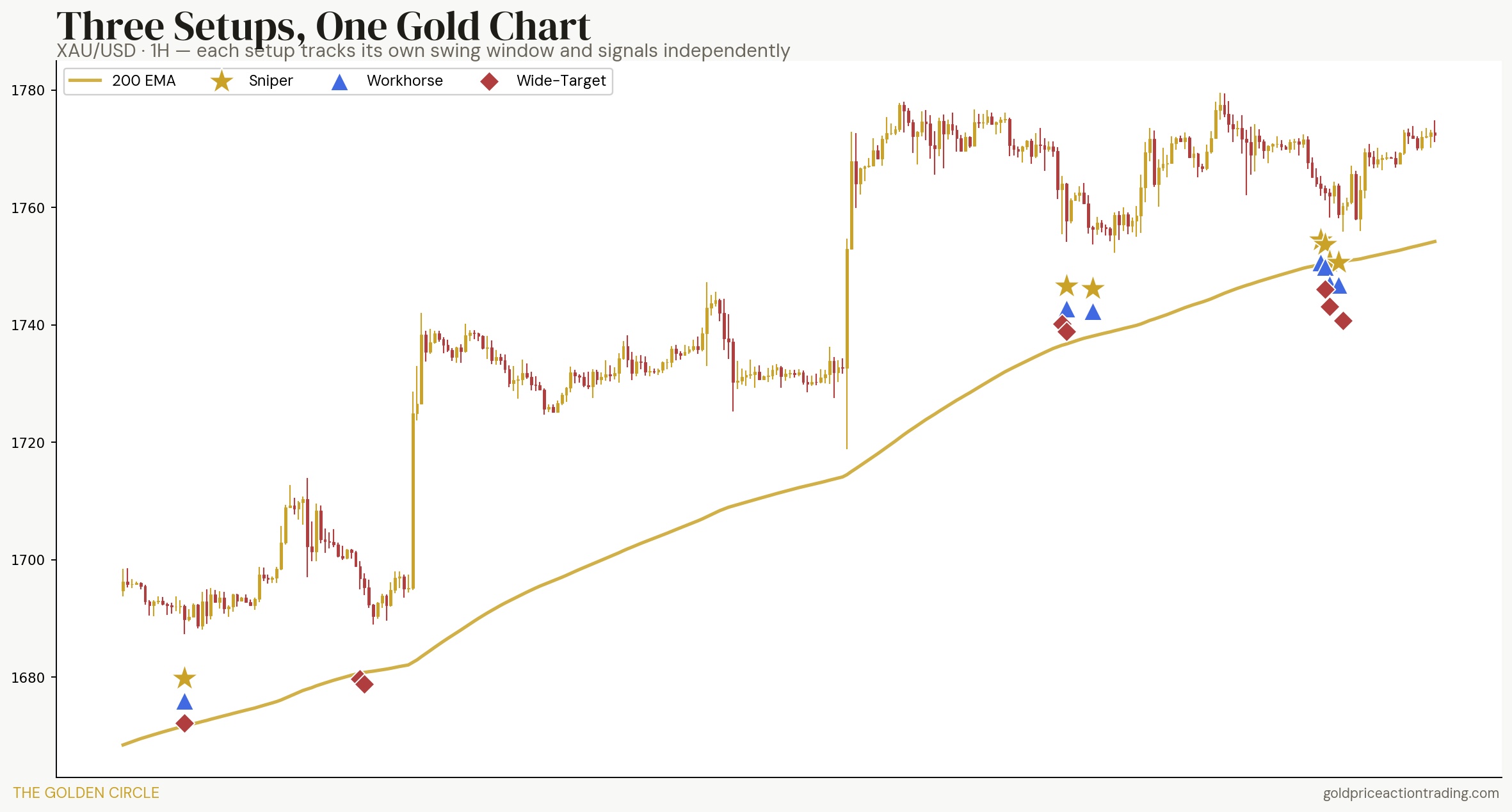
All three setups on one Gold chart. Each tracks its own swing window and signals independently.
Risk and Trade Management
A good entry is worthless without disciplined risk, and Gold punishes loose control harder than most markets. All three setups share the same defined-risk framework.
| Element | Rule |
|---|---|
| Stop loss | Fixed ATR multiple from entry (2.0 to 3.0 ATR by setup) |
| Position size | Calculated from a set risk percentage of equity |
| Trade exit | Fixed ATR target, no trailing stop |
| Time stop | Closes the trade after 48 to 96 bars if neither stop is hit |
| Averaging | None. No martingale, no adding to losers |
One deliberate choice deserves a note: there is no trailing stop. I tested trailing exits extensively, and they made this system worse, not better. The reason is structural. This is a mean-reversion bounce, not a runaway trend, so price tends to hit the target quickly and then revert. A clean fixed target captures the bounce; a trailing stop hangs on waiting for a trend that does not come and gives the gain back. The edge here is the high hit rate, not letting winners run.
Why Three Setups Beat One
The three setups use different oversold thresholds, different swing windows, and different targets. That means they fire on different bars and their quiet periods rarely overlap. Run together at a controlled risk per setup, the combined equity curve is smoother and more consistent than any one alone, because when one is dormant another is usually working.
This is the practical case for running complementary tools instead of chasing one perfect strategy. A single strategy that tries to win everywhere tends to be overfit and fragile. Three honest setups that cover each other are far more robust.
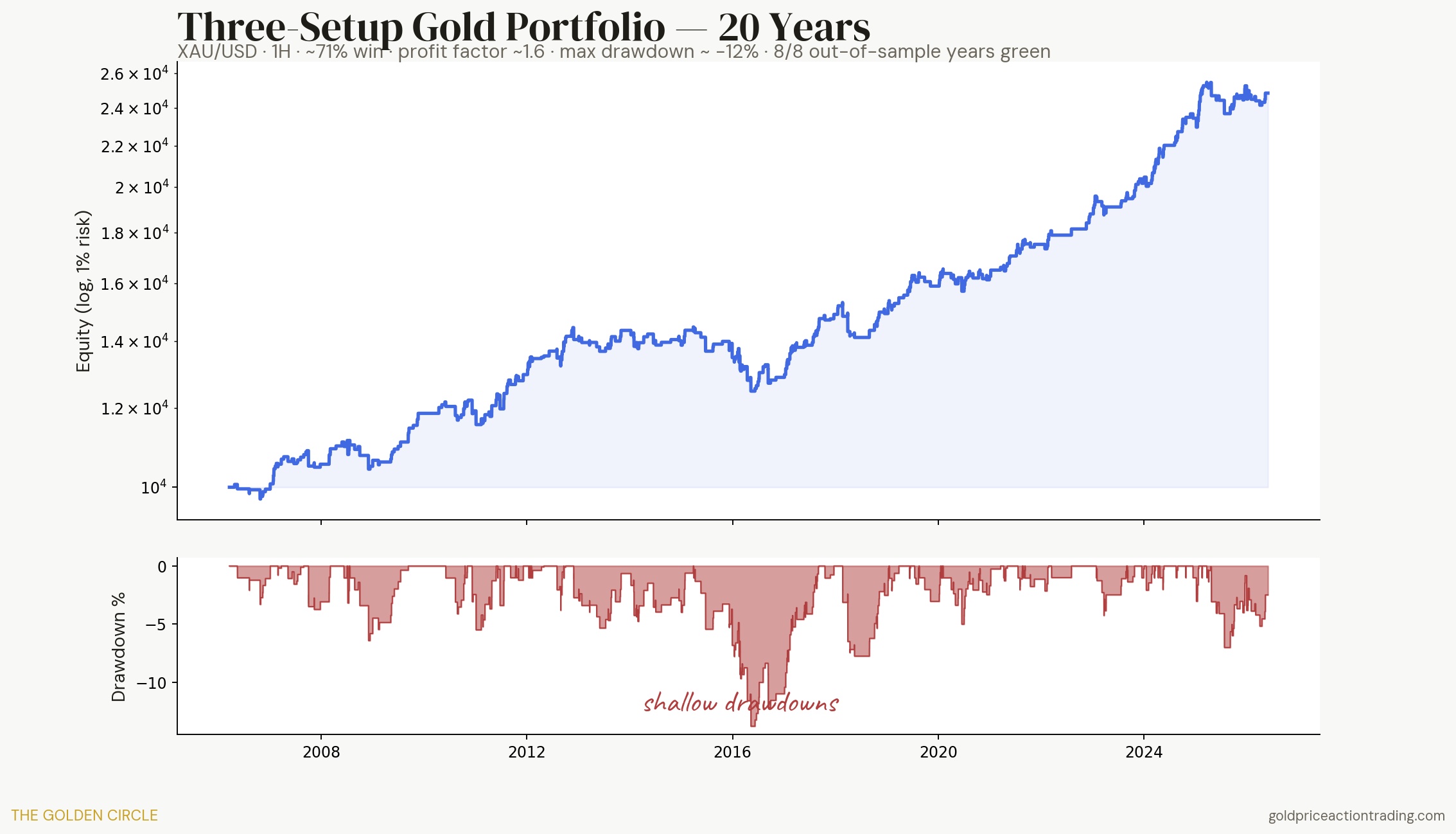
The combined three-setup equity curve. The shaded panel shows how shallow the drawdowns stay.
The Enhanced Version: Adding a Momentum Satellite
The three sweep setups all buy weakness, a dip that reclaims. That is one kind of edge. I wanted to know if a completely different kind could be bolted on without breaking what already works, so I ran the same million-configuration search across non-sweep families: breakouts, moving-average regimes, mean-reversion bands, dollar and gold-silver-ratio signals, and momentum. Almost all of them failed to survive out-of-sample. One did, a volatility breakout that buys a sharp two-ATR thrust upward while price is above the 200-EMA. In other words, a momentum setup that buys strength.
On its own it is weaker than the sweep core. But its returns are almost completely uncorrelated with the sweep system, because the two do opposite things. The sweep buys dips; the momentum leg buys breakouts. They win in different weeks. Run together, the momentum leg fills stretches where the sweep core is quiet, and the combined curve climbs faster without a matching jump in drawdown.
That gives two versions of the same engine, a tiered pair you choose between by risk appetite.
| Version | What it is | Profile |
|---|---|---|
| Core | The three sweep setups | Lower drawdown, higher win rate, calmer curve |
| Sweep + Momentum | The three setups plus the momentum satellite | Roughly double the return for a few percent more drawdown |
One honest note on the momentum leg, because it matters. In strict walk-forward testing its edge holds at sensible fixed settings but collapses the moment it is re-optimised. That is why it ships at fixed parameters and a smaller risk weight, and why the three sweep setups remain the robust core. The momentum leg is a diversifier, not a standalone system.
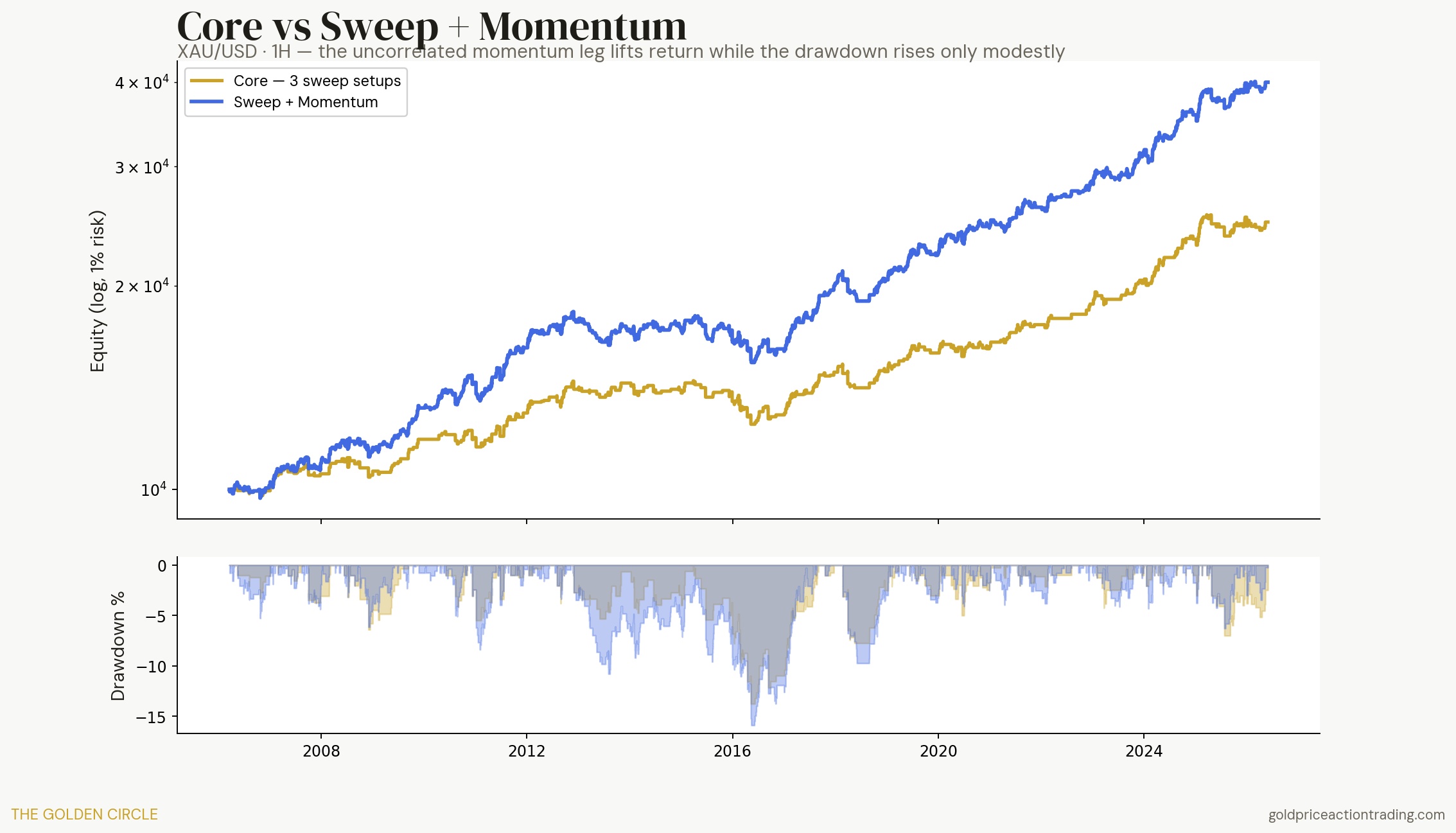
The Core sweep curve against the Sweep plus Momentum curve. The momentum leg lifts the return while the drawdown rises only modestly.
How to Deploy the System
Step 1: Get access through Golden Circle. The strategy is published invite-only on TradingView and added to your account once you join, so you can load it on any chart.
Step 2: Apply it to an XAUUSD H1 chart. Use OANDA:XAUUSD, since the system was validated on OANDA data.
Step 3: Configure one alert. All three setups route their entries and exits through the strategy’s alerts. Create a single alert set to “Order fills and alert function calls”, triggered once per bar close, and it covers everything.
Step 4: Size by risk, not a fixed lot. Recompute your lot each trade from your equity and the current ATR. Start at one percent risk per setup; you can scale up later once you have sat through a losing streak calmly.
Step 5: Paper trade first. Track every signal for at least 90 days and confirm your broker fills near the strategy’s prices before committing capital.
Honest Disclosures
This is a high win rate, modest return system. It wins about 71 percent of trades, but it caps each winner deliberately, so the per-trade return is small. It compounds through consistency and tiny drawdowns, not big swings. Under the strictest walk-forward test, the durable edge is a few percent per year at one percent risk.
It does not beat buy-and-hold gold on raw return. It wins on drawdown, roughly minus 12 percent against gold’s minus 45 percent, and on staying positive in every out-of-sample year tested.
Expect losing streaks. The worst run in twenty years was eight losing trades in a row, and a run of four or more happens roughly once a year. A 71 percent win rate still means clusters of losses are guaranteed. If a streak like that would break your discipline, trade smaller.
It is a gold-regime bet. It earns in neutral and bullish gold and treads water, with small losses, in sustained bear markets like 2013 to 2016. The 200-EMA filter limits the damage but does not eliminate it.
Live trading haircut. Backtests assume clean fills. Live execution has spread and slippage, so treat the backtest as the optimistic ceiling, not the expectation.
Trade Gold with structure, not guesswork
Both versions, the Core sweep portfolio and the enhanced Sweep plus Momentum portfolio, are available to Golden Circle members, with early access and priority support. Pick the tier that fits your risk appetite, or run both.
Frequently Asked Questions
What makes this a high win rate gold strategy?
It only trades when four conditions agree at once: an uptrend above the 200-EMA, a liquidity sweep of a swing low, a close back above that low, and oversold RSI. That selectivity produces a win rate around 71 percent across the combined three-setup portfolio.
What timeframe does it use?
The one-hour (H1) chart on XAUUSD. The edge also holds on H4 and Daily in testing, but H1 gives the best balance of trade frequency and edge, so it compounds best.
Does it use a trailing stop?
No, and that is deliberate. Trailing stops were tested and made the system worse because it is a mean-reversion bounce, not a trend-runner. Fixed ATR targets capture the bounce more reliably.
Is there a higher-return version?
Yes. The enhanced Sweep plus Momentum version adds an uncorrelated volatility-breakout leg to the same three sweep setups. It roughly doubles the backtested return for a few percent more drawdown, while the Core version stays lower-drawdown and simpler. Both are available to Golden Circle members, so you can choose by risk appetite.
How is the stop loss placed?
Each setup uses a fixed ATR-multiple stop, between 2.0 and 3.0 ATR from entry, with position size calculated from a set risk percentage. Trades also carry a time stop and no averaging down.
Does it work on other instruments?
The logic is instrument-agnostic, but validation was done on OANDA XAUUSD specifically. Other venues and markets have different costs and execution, so test on your own feed before scaling capital.
Risk Disclaimer: This content is for educational purposes only and does not constitute financial advice. Past performance shown in backtests does not guarantee future results. Gold trading involves substantial risk of loss. The author publishes systematic strategies as research and educational tools, not as recommendations to trade with capital. Always paper trade new systems for at least 90 days before deploying real capital, and never trade with money you cannot afford to lose. See full disclaimer.