Gold 1-Minute Scalping Indicator for XAUUSD – Precision Mean Reversion Entries on TradingView [2026 Guide]
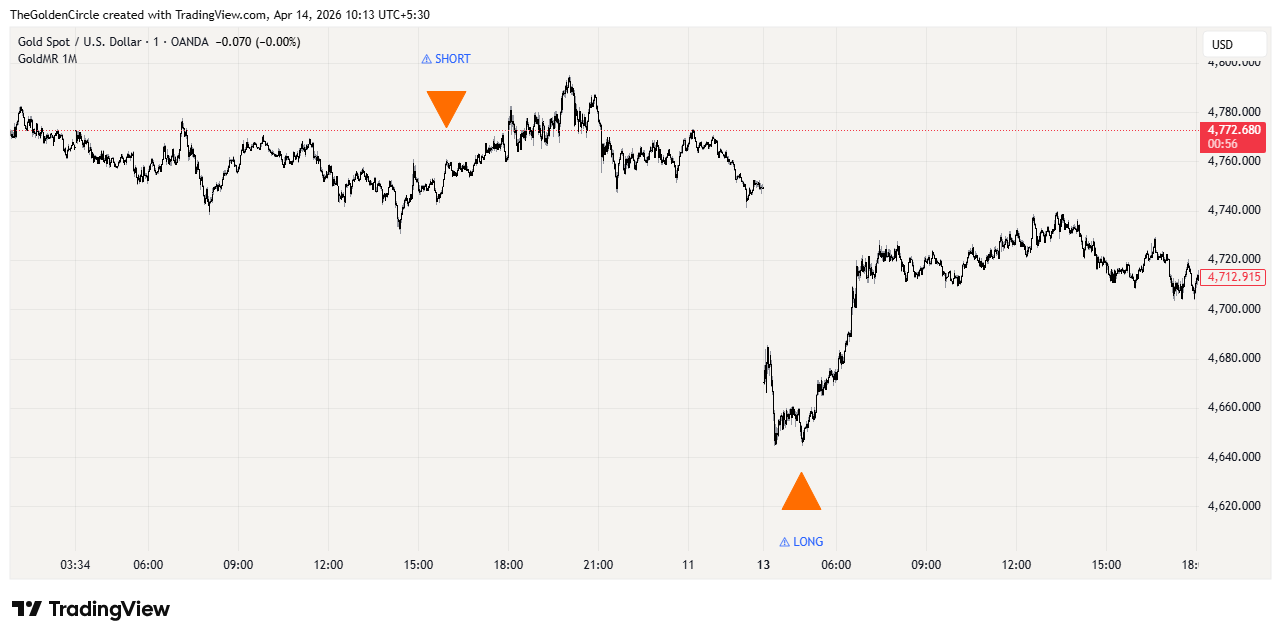
If you’ve used the H1 version of the Gold Mean Reversion indicator and wished you could get tighter entries, this is the tool that solves that problem. The 1M Scalper uses the exact same Ornstein-Uhlenbeck mathematical engine but with every parameter recalibrated for the speed, noise, and micro-structure of 1-minute Gold price action. It turns the H1’s “reversal zone” into a precise “reversal bar.” Here’s the complete breakdown of how it works, why it needed to exist as a separate version, and how to use it for high-probability XAUUSD scalping.
Contents
- 1. What the 1M Scalper Does (and How It Differs from H1)
- 2. Why You Can’t Just Use the H1 on a 1-Minute Chart
- 3. Signal Types on the 1M Chart
- 4. The Multi-Timeframe Scalping Workflow (H1 + 1M)
- 5. Best Times to Scalp Gold on the 1-Minute Chart
- 6. Reading the Chart: Backgrounds, Filters and the Info Panel
- 7. Key Settings – What Changed from H1 and Why
- 8. 8 Scalping Rules I’ve Learned the Hard Way
- 9. Real 1M Scalp Examples from Live Gold Charts
- 10. How to Get Access (Invite Only)
- 11. FAQ: 6 Questions Gold Scalpers Always Ask
1. What the 1M Scalper Does (and How It Differs from H1)
The Gold Mean Reversion v8 [1M Scalper] is the companion to the H1 swing trading version. Both use the same core engine – the Ornstein-Uhlenbeck stochastic process with Z-Score analysis, trend filtering, and exhaustion verification. But the 1M version is calibrated entirely for the speed of 1-minute Gold bars.
While the H1 version identifies the ZONE (where price is overextended), the 1M version pinpoints the exact ENTRY (the precise bar to pull the trigger).
Think of it this way. The H1 indicator says “Gold is in a major reversal zone right now.” That’s valuable, but it might be 200 points early. The 1M indicator says “The reversal is confirmed on micro-structure – enter now.” That’s the difference between a good trade idea and a precise execution.
The one-line version: H1 tells you WHAT to do. 1M tells you WHEN to do it. Same math, different calibration, dramatically better entries.
Signal frequency comparison
| Metric | H1 Version | 1M Scalper |
|---|---|---|
| Normal signals | 3-5 per month | 1-5 per trading session |
| Extreme signals | 2-4 per year | 1-3 per week |
| Target trade duration | Hours to days | Minutes to 1-2 hours |
| Z-Score exit threshold | 0.5 | 0.3 (faster close) |
| HTF filter | 4H | 15M |
| Best use case | Swing trades, major tops/bottoms | Scalps, precision entries for H1 signals |
2. Why You Can’t Just Use the H1 Indicator on a 1-Minute Chart
This is the first question everyone asks. And it’s a good question. If the math is the same, why not just apply the H1 version to a 1M chart?
Because the 1-minute timeframe is a completely different animal. Here’s what changes when you drop from H1 to 1M on Gold:
Noise is roughly 60 times higher. What looks like a trend on the 1M chart is often just a wiggle on H1. The H1 parameters would interpret every micro-move as a meaningful deviation and fire signals constantly.
Z-Scores spike and revert within minutes, not hours. On H1, a Z-Score of 2.0 might persist for several bars. On 1M, it can spike to 2.5 and snap back to zero in three minutes. The entry and exit logic has to be faster.
The OU half-life model needs shorter data windows. On H1, the indicator uses hours of data to estimate mean reversion speed. On 1M, that same lookback would be stale.
Trend detection has to be faster but still stable. This is the hardest part. The 1M version uses a specifically tuned Schmitt trigger that reacts within minutes while still filtering out noise.
RSI moves so quickly that traditional OB/OS duration checks don’t apply. On 1M, RSI flips above and below 70 every few bars. The RSI duration counter is disabled by default on the 1M version.
I tested this: During development, I applied the H1 parameters to a 1M chart as a control test. Over one London session, it generated 47 signals. Most were losers. The calibrated 1M version generated 4 signals in the same session, and 3 were winners. That’s the difference parameter tuning makes.
3. Signal Types on the 1M Chart
The signal system is identical to the H1 version. Same triangle shapes, same colour coding, same logic. What changes is the frequency and the context in which they fire.
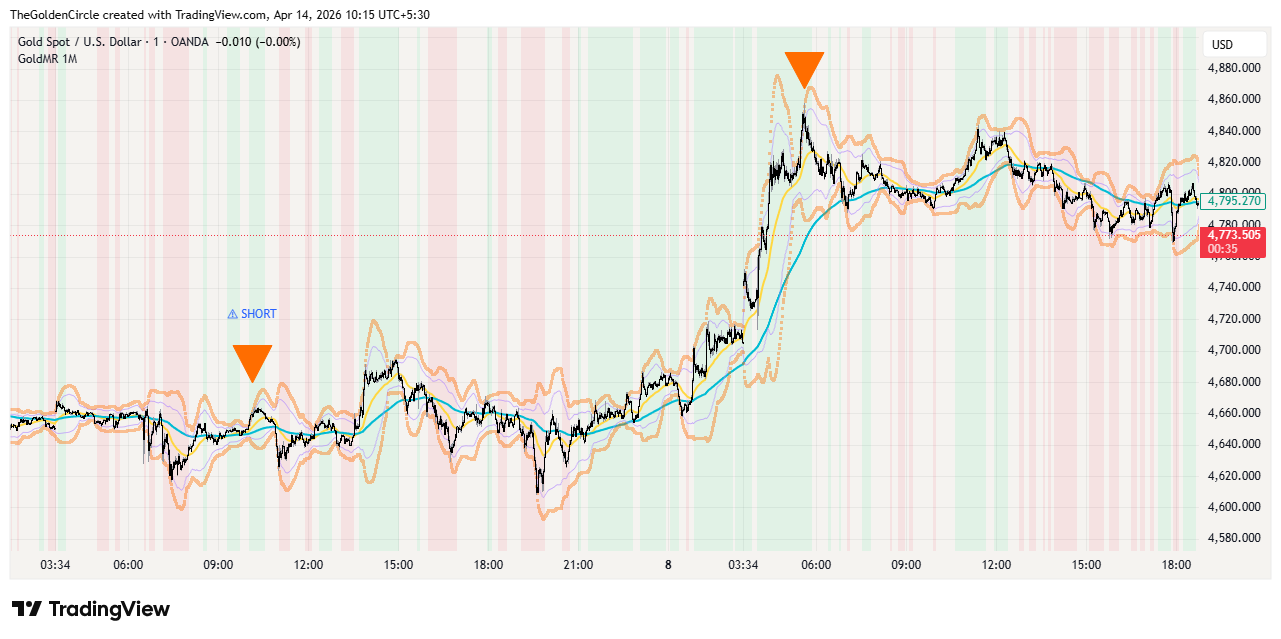
▲ LONG – Normal with-trend buy. Price dropped 2 standard deviations below the 1M mean in a bullish micro-regime. Fires 1-5 times per session.
▼ SHORT – Normal with-trend sell. Price pushed 2 standard deviations above the 1M mean in a bearish micro-regime. Quick scalp entries.
⚠ EXTREME – Exhaustion-confirmed on 1M micro-structure. Rare even on this timeframe. 1-3 per week. High conviction for larger scalp moves.
✕ EXIT – Z-Score reverted to 0.3 (tighter than H1’s 0.5). Close position fast. The mean reversion snapback is done.
On H1, a normal signal might lead to a trade lasting 4-12 hours capturing $50-$150. On 1M, a normal signal is typically a 5-30 minute trade capturing $5-$30. When a 1M normal signal fires inside an H1 extreme zone? That’s the highest-probability scalp setup this system produces.
4. The Multi-Timeframe Scalping Workflow (H1 + 1M)
This is the most powerful way to use the 1M scalper. Not as a standalone tool, but in combination with the H1 version. Higher timeframe for direction, lower timeframe for execution.
Step 1: H1 Chart – Watch for the extreme signal or read the trend. Keep the H1 indicator running on one TradingView tab. When you see an extreme signal fire, you know Gold is in a major reversal zone. Even without an extreme signal, the H1 background colour tells you the dominant direction.
Step 2: 1M Chart – Wait for a matching signal in the same direction. If H1 says extreme SHORT, switch to the 1M chart and wait for a normal SHORT triangle. This confirms the reversal on micro-structure.
Step 3: Enter on the 1M signal bar with a tight stop. Your entry is now much closer to the actual turning point. Place your stop beyond the most recent 1M swing extreme.
Step 4: Manage using 1M exits for scalps or H1 targets for swings. For a quick scalp, exit when the 1M EXIT signal fires. For a larger swing, keep the position open and manage using the H1 chart’s Exit signal.
A real example of how this improves entries
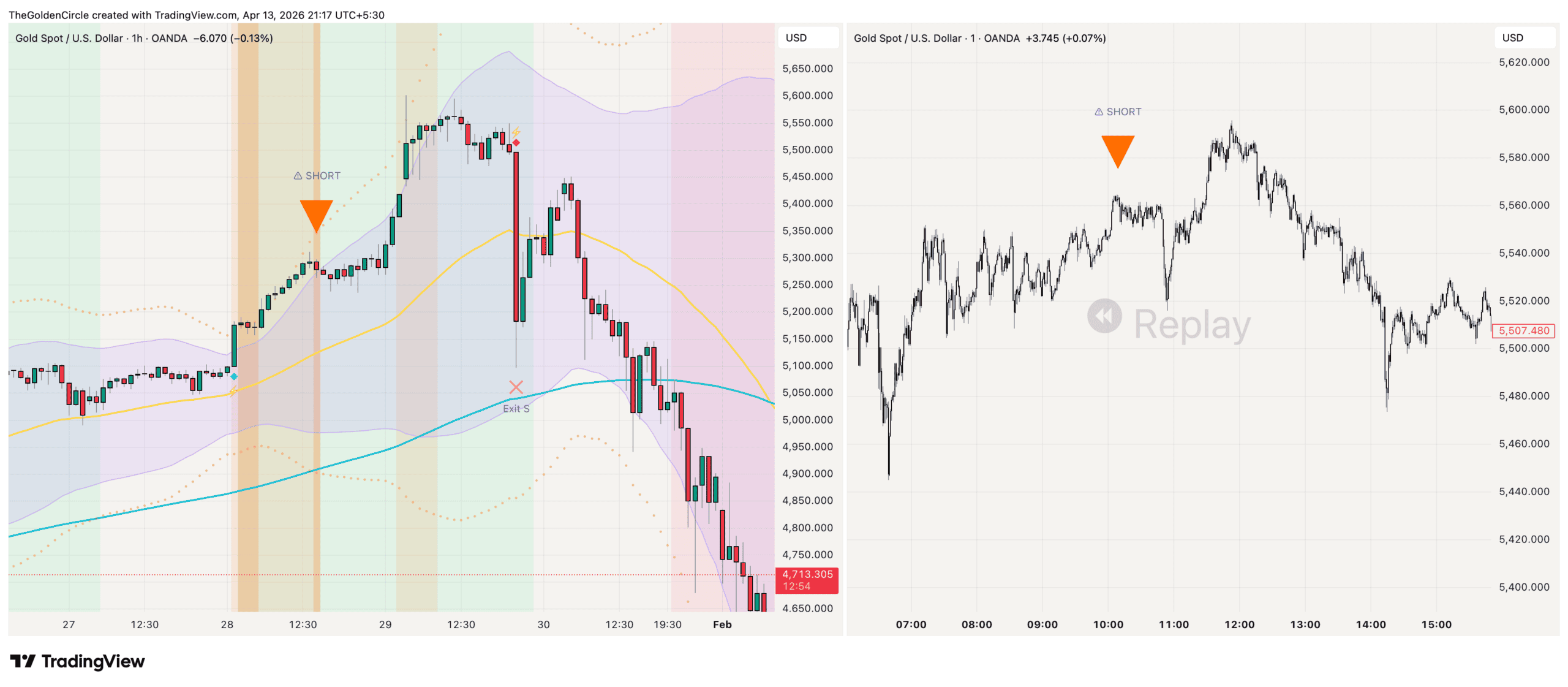
The H1 extreme SHORT signal fires at $5,300 while Gold is still pushing toward $5,600. If you enter at $5,300, you’re sitting through $300 of drawdown. With the 1M version, you wait. Gold climbs to $5,560. The 1M SHORT signal fires. Your entry is $260 better. Your stop is 20 points above $5,580 instead of 300 points above $5,300. The risk-to-reward ratio goes from mediocre to exceptional.
For the complete H1 indicator guide including the Ornstein-Uhlenbeck math explained in detail, read: Gold Mean Reversion Indicator for XAUUSD Swing Trading [H1]
5. Best Times to Scalp Gold on the 1-Minute Chart
Not all hours are created equal for Gold scalping. The 1M indicator produces the cleanest signals when liquidity is high and spreads are tight.
London-New York Overlap (13:00-17:00 GMT) – Highest Gold liquidity of the day. Tightest spreads. Most reliable signals from the 1M indicator. This is the prime window for scalping XAUUSD.
London Session (07:00-16:00 GMT) – Strong liquidity throughout. Gold often makes its daily directional move during London. Great for both normal and extreme 1M signals.
New York Session (13:00-22:00 GMT) – Good liquidity but can be choppy after the overlap ends around 17:00 GMT. Late New York often sees mean reversion after the day’s major move.
Asian Session (23:00-07:00 GMT) – Low Gold liquidity. Wider spreads. Thin price action produces unreliable 1M signals. Avoid scalping Gold during these hours unless major news breaks.
Timing tip: Avoid the first 5 minutes after major economic releases (NFP, FOMC, CPI). The gap filter in the indicator handles this automatically by detecting price gaps and suppressing signals (teal background), but it’s good practice to step away from the screen during those spikes. The best scalping opportunities often come 15-30 minutes after the initial news reaction, when price starts reverting toward the mean.
6. Reading the Chart: Backgrounds, Filters and the Info Panel
The visual system is identical to the H1 version. Same colour codes, same info panel fields, same logic.
Background colors
Green – Bullish micro-regime, focus on LONG scalps.
Red – Bearish micro-regime, focus on SHORT scalps.
Yellow – Squeeze detected, hands off.
Teal – Gap detected (news spike), wait for mean to catch up.
On the 1M chart, backgrounds change more frequently than on H1. This is normal. The key is to only take signals that match the current background colour. LONG triangles on green background. SHORT triangles on red background. Anything else, let it pass.
The info panel on 1M
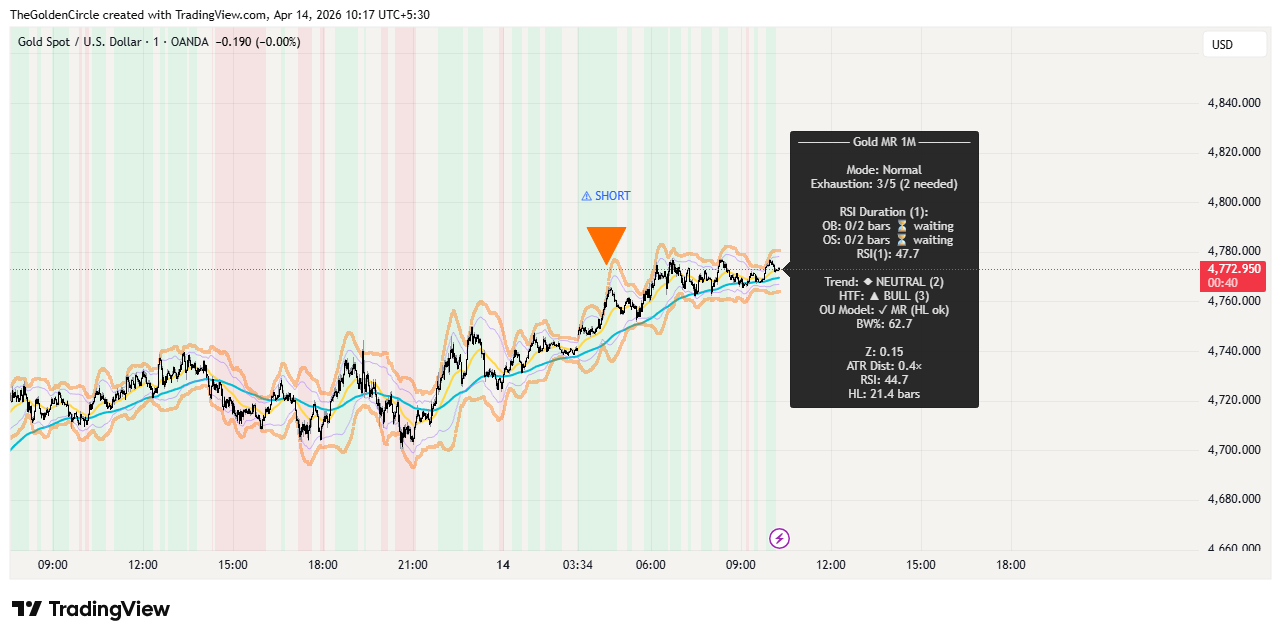
The info panel displays the same fields as the H1 version: Mode, Exhaustion score, RSI Duration, Trend state, HTF override (set to 15M instead of 4H), OU Model status, Bollinger Bandwidth, Z-Score, ATR Distance, RSI, and Half-Life. On 1M, the values update every bar (every minute). Watch the Z-Score value in particular – when it starts approaching 2.0, a signal might be imminent.
7. Key Settings – What Changed from H1 and Why
The mathematical model is identical. What changes is the calibration. Every parameter has been adjusted to match the behaviour of 1-minute Gold bars.
| Setting | H1 Value | 1M Value | Why It Changed |
|---|---|---|---|
| Trend smoothing | Medium | Fast | 1M micro-trends are shorter. Needs to react within minutes. |
| Z-Score exit | 0.5 | 0.3 | Positions close faster. Waiting for 0.5 on 1M leaves money on the table. |
| HTF override | 4H | 15M | Responsive enough for 1M scalping but stable enough to prevent noise. |
| RSI Duration | Enabled | Disabled | On 1M, RSI flips OB/OS every few bars. Duration counting generates noise. |
| Exhaustion lookback | 10 bars (10h) | 12 bars (12min) | Wider bar count but shorter time. Captures micro-exhaustion patterns. |
| Slope smoothing | Standard | Reduced | Trend score needs to detect slope changes within minutes. |
Default settings are ready to go: Like the H1 version, the 1M defaults are pre-tuned from extensive live testing on Gold. Start with defaults and trade them for at least two weeks before making adjustments.
8. 8 Scalping Rules I’ve Learned the Hard Way
These aren’t from a textbook. They’re from years of scalping Gold on the 1-minute chart.
1. Trade during London and New York sessions only. The indicator works technically during Asian hours, but thin liquidity produces choppier price action and wider spreads.
2. Avoid the first 5 minutes after major news releases. The gap filter handles this automatically, but the real trade comes 15-30 minutes later when price starts reverting.
3. When the background is green, focus on LONG signals from dips. Don’t fight the micro-trend.
4. When the background is red, focus on SHORT signals from rallies. Same logic. Trust the trend filter.
5. Yellow background = hands off. A squeeze is building. Wait for it to resolve.
6. Keep the H1 chart open alongside for context. If H1 is bullish, take 1M longs with more confidence. If H1 is bearish while 1M flips green, reduce your size.
7. Don’t try to catch every signal. Pick the ones that align with H1 direction, occur during high-liquidity hours, and have the strongest info panel readings.
8. Use this indicator alongside price action, not as a replacement. The best entries combine the statistical signal with a visible candlestick pattern like a pin bar or engulfing candle.
9. Real 1M Scalp Examples from Live Gold Charts
Example 1: London session SHORT scalp with H1 confirmation
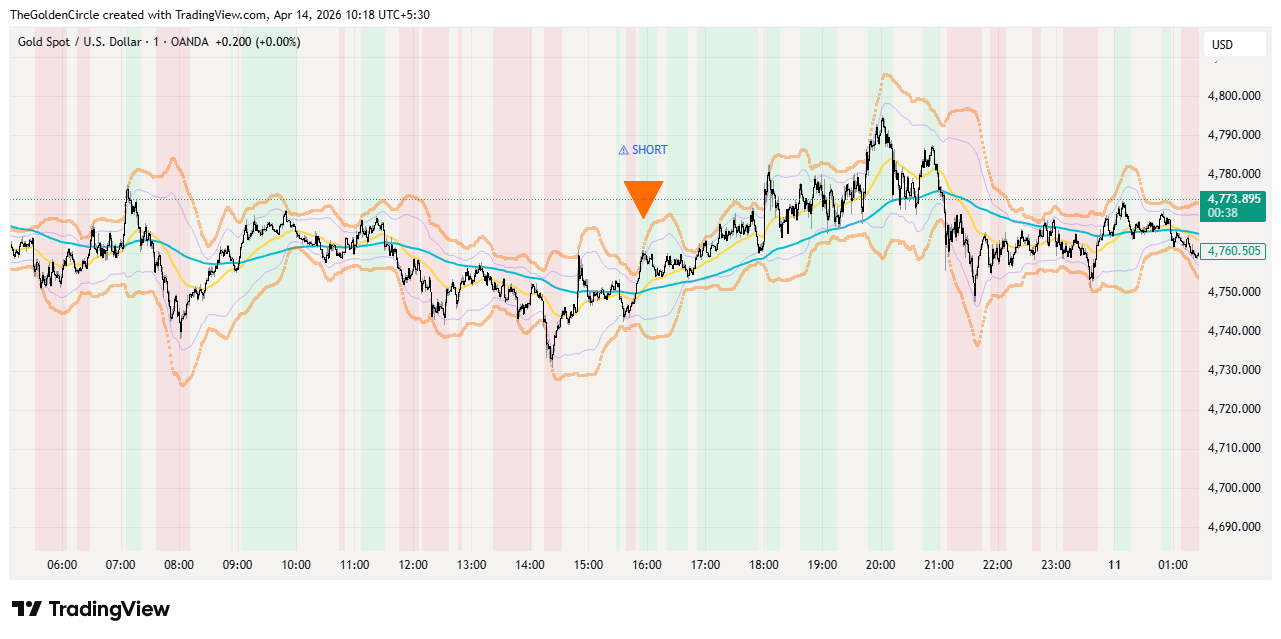
The H1 chart was showing a bearish regime. On the 1M chart, price pushed up against the mean, Z-Score spiked to 2.2, and the SHORT signal fired. Within 15 minutes, price snapped back to the mean. Clean entry, clean exit, no stress.
Example 2: Multi-timeframe extreme entry near Gold top
The H1 fired an extreme SHORT signal early. The 1M SHORT signal fired about 30 minutes later, roughly $180 closer to the actual top. The subsequent reversal moved over $300 within the day.
Example 3: LONG scalp during a bullish 1M regime
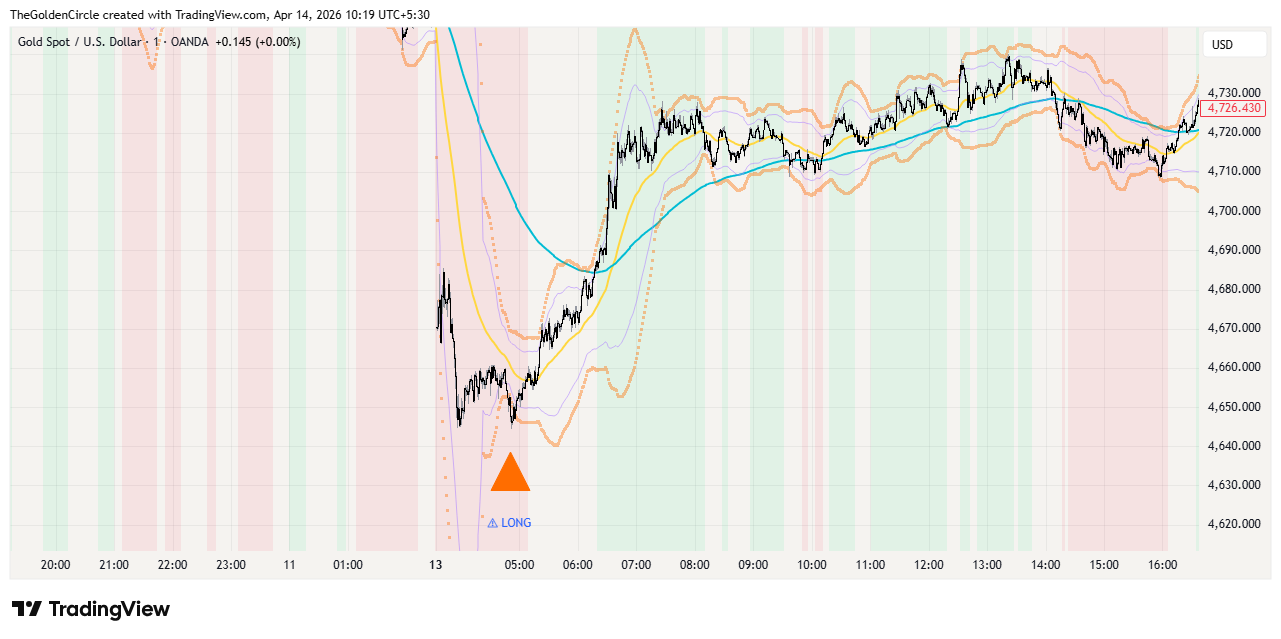
A quick dip during a bullish 1M regime. The Z-Score dropped to -2.3 on a fast selloff. The LONG signal fired at the bottom of the dip. Price bounced $12 within 20 minutes and the EXIT signal triggered right on schedule.
Example 4: Gap filter saving you from a news spike

A major news release caused a $30 spike in seconds. The indicator detected the gap, turned the background teal, and blocked all signals. After the initial spike settled (about 12 minutes), the teal cleared, and a SHORT signal fired on the genuine reversion move. Patience, protected by the algorithm.
10. How to Get Access (Invite Only)
This indicator is invite-only on TradingView. Request access by sending a DM with your TradingView username.
Request Access on Telegram
View on TradingView
Also available: H1 Swing Trading version | BTC Mean Reversion [H1] | RSI Duration Counter
Setting up alerts for hands-free scalping
The 1M indicator comes with full alert support: Long Entry, Short Entry, Extreme Long, Extreme Short, Exit Long, Exit Short, or Any Entry (combined). Set alerts on the 1M chart so you get notified the moment a signal fires, even if you’re watching the H1 chart.
11. FAQ: 6 Questions Gold Scalpers Always Ask
1. Why can’t I just put the H1 indicator on a 1-minute chart? ▼
The 1-minute timeframe has fundamentally different characteristics. Noise is roughly 60 times higher, Z-Scores spike and revert within minutes, and the OU half-life model needs a shorter calibration window. I tested this during development and the H1 parameters produced 47 signals in a single London session on 1M. The calibrated 1M version produced 4. Quality over quantity.
2. How many scalping signals does the 1M indicator generate per day? ▼
Expect 1 to 5 normal filtered signals per trading session and 1 to 3 extreme exhaustion signals per week. The best sessions are during London and New York overlap. On quiet days, you might get zero or one signal. That’s the indicator doing its job.
3. What is the best time to scalp Gold XAUUSD on the 1-minute chart? ▼
The London session (07:00 to 16:00 GMT) and especially the London-New York overlap (13:00 to 17:00 GMT) produce the cleanest signals. Avoid the Asian session (23:00 to 07:00 GMT) for scalping and stay out for the first 5 minutes after major economic releases.
4. Does the 1M scalper work on Gold only or other assets too? ▼
This version is specifically calibrated for Gold XAUUSD on the 1-minute timeframe. The trend filter speed, Z-Score exit level (0.3), exhaustion lookback (12 bars), and HTF override (15M) are all tuned for Gold’s unique volatility profile. Separate versions are available for BTC/USD and Forex pairs.
5. How do I combine the 1M scalper with the H1 version? ▼
Keep the H1 indicator on one TradingView chart and the 1M indicator on a second chart. The H1 gives you directional context. When the H1 fires an extreme signal, switch focus to the 1M chart and wait for a matching signal. This typically improves entries by 50 to 200 points. See the H1 indicator guide for a full walkthrough.
6. What stop loss and take profit should I use? ▼
The indicator provides built-in Exit signals when the Z-Score reverts toward zero (exit threshold is 0.3 on 1M). For stop losses, place them beyond the most recent micro-swing on the 1M chart – typically 3-8 points on Gold. A common approach is 1:1 or 1:1.5 risk-to-reward with a trailing stop. Never risk more than 1% of your account per scalp trade.
Read next:
Gold Mean Reversion Indicator for XAUUSD Swing Trading [H1 TradingView] – Complete Guide
Asligold TradingView Indicators – Complete Gold Trading Toolkit
Gold Momentum Edge v9 – Quantitative Trend Following Strategy
Risk Disclaimer
Trading Gold (XAUUSD) and other financial instruments carries substantial risk. Scalping on the 1-minute timeframe involves high-frequency decision-making and can lead to rapid losses if proper risk management is not applied. Past performance does not guarantee future results. The Gold Mean Reversion v8 [1M Scalper] indicator is for educational and informational purposes only – it is not financial advice. Always use stop-loss orders, never risk more than 1% of your account per trade. No indicator is 100% accurate. The final trading decision is always yours. This website contains affiliate links – see full disclaimer.