Learning how to read forex signals starts with understanding the complete trade instruction, not copying the first “buy” or “sell” message you see. A useful signal identifies the instrument, direction, entry conditions, invalidation, targets and timing. It still does not tell you what size is suitable for your account or guarantee a profitable outcome.
This guide explains how to read forex signals using hypothetical XAUUSD examples. Gold CFD specifications differ from currency pairs, so the examples use explicit dollar prices and ounces. None of the example messages is a live signal.
How to read forex signals: the seven essential fields
| Field | What it answers | What to clarify |
|---|---|---|
| Instrument | What is being traded? | Exact symbol and account contract |
| Direction | Buy or sell? | Whether it opens or closes exposure |
| Time | When was it issued? | Timezone, expiry and cancellation rule |
| Entry | What condition activates the idea? | Market, limit, stop or confirmation |
| Stop loss | Where is the planned protective exit? | Actual price and execution assumptions |
| Targets | How is profit-taking managed? | Portions, order and remaining stop |
| Risk | What could your position lose? | Your equity, volume and costs |
A phrase such as “buy gold now” leaves most of these questions unanswered. A range such as “buy 4,000–4,002” also needs an explanation: is any entry in the range allowed, are multiple entries intended, or is the range only a zone to watch? Do not treat a zone as permission to stack positions without a total exposure plan.
Order type matters. A buy limit generally seeks an entry below the current available market; a buy stop generally waits for a higher trigger. A market order seeks available execution when submitted. The MetaTrader order guide explains the mechanics. Your broker’s available order types and execution rules remain relevant.
Interactive signal review checklist
Use this checklist while learning how to read forex signals. Checking every box means that you have reviewed the listed information. It is not a safety rating, a suitability assessment or a recommendation to trade. If a detail cannot be verified, leave the corresponding box unchecked.
Three examples of reading a gold signal
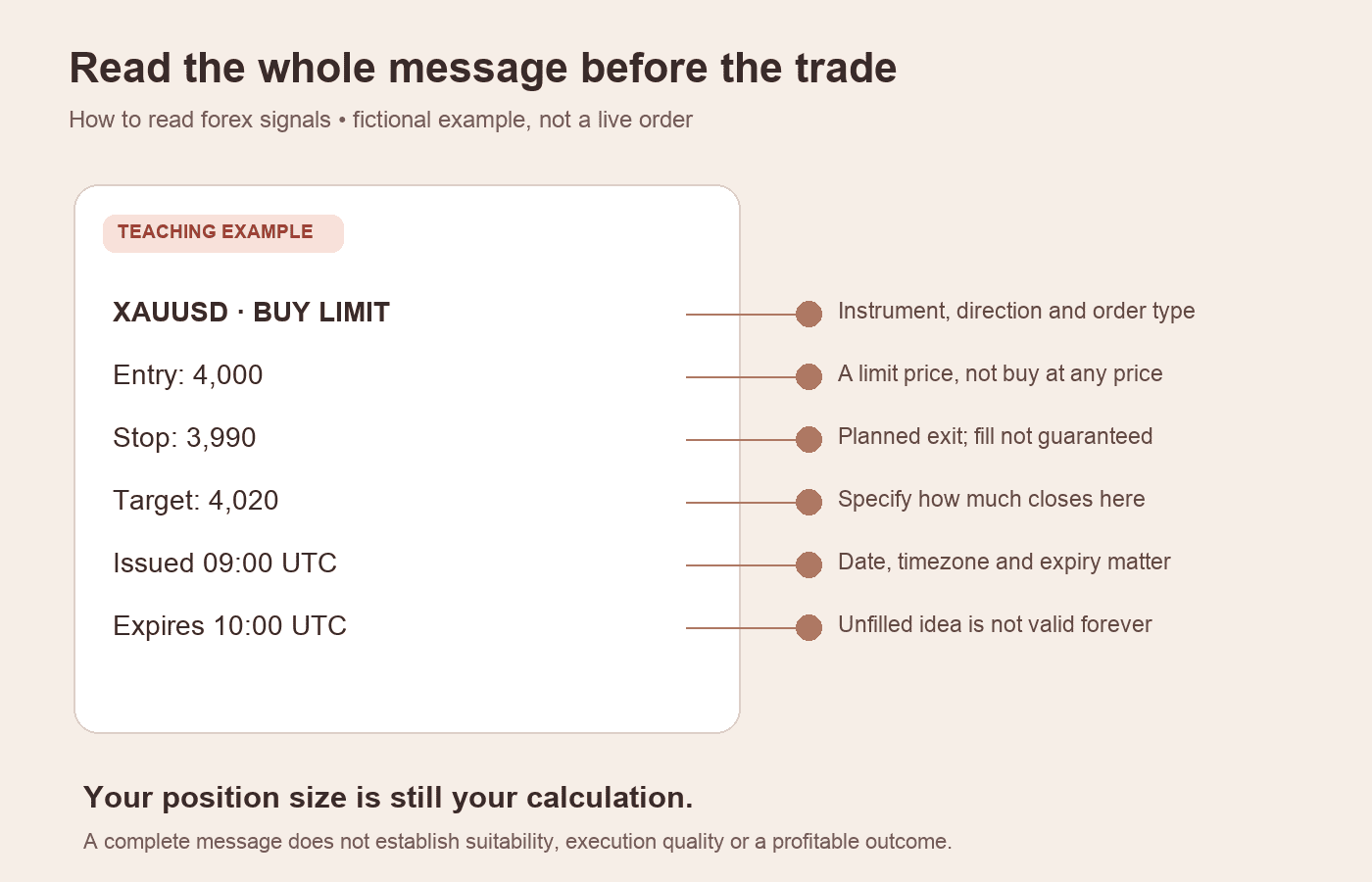
1. A complete hypothetical buy
XAUUSD buy limit 4,000
Stop 3,990
Target 4,020
Issued 09:00 UTC; valid until 10:00 UTC unless cancelled
One entry; full exit at the target; no adding to a losing position
The direction is long. The intended entry is a limit at $4,000, not an instruction to buy at any available price. The protective distance is $10 and target distance is $20 per ounce. If your actual contract is 100 ounces per lot and your hypothetical size is 0.02 lot, gross stop loss would be $20 and gross target gain $40 before separate costs.
The expiry condition matters. If the entry never occurs before 10:00 UTC, the original message does not automatically remain valid all day. A provider may publish a new plan, but that should be a new instruction with a new timestamp. Keep the distinction between an unfilled idea and an open trade.
2. The same idea after price has moved
Suppose you see the message late and the available buy entry is $4,005. Keeping the original stop and target gives a $15 stop distance and a $15 target distance. The original gross risk:reward of 1:2 has become 1:1. At two ounces, the gross stop loss rises from $20 to $30.
Learning how to read forex signals includes noticing this change before acting. The provider’s original example cannot make your later entry equivalent. Do not silently reinterpret a buy-limit instruction as a market entry. Recalculate or wait for clarification; missing a trade is different from executing a changed plan unknowingly.
3. A sell with multiple targets
Consider a hypothetical sell at $4,000, stop at $4,010, first target at $3,990 and second target at $3,980. The message says to close half at each target. At two ounces total exposure, closing one ounce at the first target earns $10 gross and one at the second earns $20 gross. Combined gain is $30, not the $40 that a full position held to the second target would earn.
If the remaining ounce instead exits at the original stop after the first target, the first $10 gross gain is offset by a $10 gross loss. Separate costs can make the net outcome negative. The rule for the remaining stop after a partial exit therefore needs to be explicit; it cannot be inferred from a target screenshot.
A provider’s lot size is not your risk budget
A signal provider might have a different account balance, contract, leverage or existing exposure. Copying 0.10 lot does not copy the same account percentage. With a 100-ounce contract and a $10 adverse move, 0.10 lot loses $100 gross. That is 1% of $10,000 but 20% of $500.
Work from your own executable entry and stop, then check the position’s dollar consequence. Our gold profit and loss calculator can help with price arithmetic. Check whether costs are included before comparing a tool’s output with the account statement.
Margin is another separate check. A platform accepting an order only establishes that its operational requirements were met at that moment. It does not establish that the risk is appropriate. Multiple gold signals can also create one concentrated position even if they have different message IDs or slightly different entries.
Notification delay, internet latency and broker quotes can produce different fills across subscribers. Keep the issue time, time received, time acted on and actual fills in your journal. This helps distinguish a provider’s reported result from the trade that was realistically available to you.
How to evaluate a signal service without relying on headlines
Ask for a complete record over a stated period, including losses, cancelled ideas, open positions, costs and changes to the original instructions. A list of winning pips omits the account size and dollar risk. An unusually high win rate can coexist with large losses, while deleted or edited messages can make a record difficult to verify.
Keep backtests, demo accounts and live results labelled separately. Each can be informative, but they are different evidence. Check how the provider defines a win, handles several targets and counts a signal that never reached its entry. A reporting method that credits every target as a separate full-size win can exaggerate the result of one actual position.
The CFTC’s social-media advisory warns about misleading trading expertise, fake testimonials and signal services that may have hidden costs or fail to perform as promoted. Check the applicable rules in your country and do not treat a polished channel or large follower count as verification.
Service terms should explain subscription charges, cancellation, what support includes and any broker relationship. An introducing broker or affiliate may receive compensation linked to registrations or trading activity. That creates a commercial interest worth understanding; it is not a reason to increase your trading frequency or use an unsuitable account.
For the wider learning sequence, return to the price action learning guide. Chart context, market timing and risk remain separate parts of the process even when someone else supplies an idea.
Keep an update log, not just the winning screenshot
Suppose a fictional message is issued at 09:00, amended at 09:15 and cancelled at 09:40. Preserve all three timestamps. If your order filled at 09:10, a later cancellation of an unfilled idea may not describe what should happen to your open position. The service needs a clear rule for that distinction. Do not assume that deleting a message closes an order in your account.
A useful record has separate fields for the original instruction, each update, when you received it and what you actually did. If an update arrived while your connection was unavailable, record that too. The purpose is to reconstruct the available information, rather than judge the decision using messages you had not yet seen.
For a moved stop, retain both the original and replacement levels. A later screenshot showing a small loss cannot establish that everyone had the revised stop in place. If the provider reports a result based on the update, ask how the report handles subscribers who could not execute it and whether the original record remains accessible.
This is part of learning how to read forex signals accurately: distinguish the published plan, the changing instructions and your own execution. You can test the record-keeping process on a demo account before considering any live service. A complete audit trail makes disagreements easier to understand; it does not make the trade itself reliable.
Using our community and broker information
The Golden Circle information page describes our signals community. Read the current terms and apply the same review standards discussed here. Educational discussion and trade ideas do not remove the need for your own decisions and account checks.
If you already use Exness and are reviewing a partner relationship, see our guide to changing an Exness IB. Verify current eligibility and the broker’s process before requesting a change. An IB change is an account relationship decision, not evidence that future trades will improve.
Learning how to read forex signals is a process of making assumptions explicit. Start with demo examples, document the full instruction and compare planned with actual outcomes. The aim is to understand what happened, including the losing cases, rather than collect attractive screenshots.
How to read forex signals: questions and answers
What do SL and TP mean?
SL means stop loss and TP means take profit. They describe intended exit levels. Check the actual prices, order settings and execution conditions.
Can I enter after the signal’s entry price has passed?
Only a clearly specified plan can answer that. A different entry changes risk and reward. Do not assume the original message authorises a late market entry.
Does every target mean a separate trade?
No. Targets may refer to portions of one position. Ask how much is closed at each and what happens to the remaining stop.
Should I use the provider’s lot size?
Not without independently checking your equity, contract, entry, stop and other exposure. The same lot number can represent a very different account risk.
Are free signals safer than paid signals?
Price alone does not establish quality or safety. Both require review of evidence, terms, conflicts and actual instructions.
Does completing the checklist mean I should trade?
No. It only records that you reviewed the listed details. The trade can still be unsuitable, incomplete in other ways or unprofitable.