Gold Pullback Trading Strategy for XAUUSD H1 – Quantitative Momentum Indicator with ATR Stops and Trailing Management on TradingView
Buying pullbacks on Gold sounds simple until you actually try it. Most traders learn the hard way that not every dip is worth buying. Some dips are the start of a reversal. Some happen during choppy sideways markets where there’s no trend to pull back into. And some happen after blow-off tops where the “dip” keeps dipping for another $300. I know because I tested all of them. After analysing 5,200+ bars of XAUUSD data spanning 20 years and screening 28 different strategy models, I found the specific conditions under which a gold pullback trading strategy actually works. The result is two tools: an indicator for live trading with 7 alert conditions, and a companion strategy for backtesting on your broker’s data. This post covers how the system identifies which pullbacks are worth buying, how the trade management turns good entries into profitable exits, and how it fits alongside the rest of the Asligold indicator toolkit.
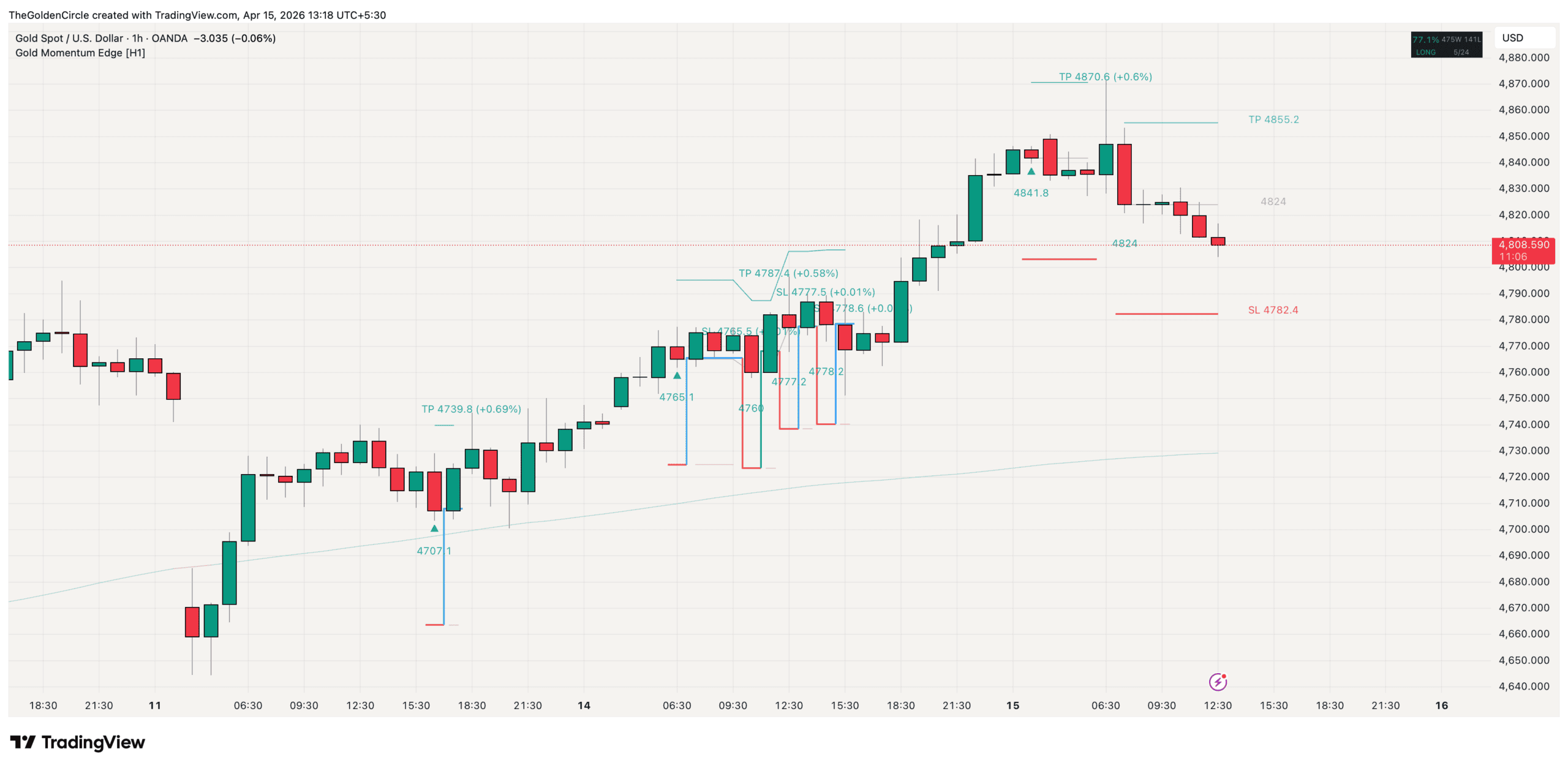
Gold Momentum Edge [H1] on a live XAUUSD chart. Pullback entries within confirmed momentum trends, managed with ATR-adaptive stops (red), automatic breakeven (blue), and trailing profit protection (green).
Contents
- 1. Why Most Gold Pullback Strategies Fail
- 2. Indicator for Live Trading, Strategy for Backtesting
- 3. How the System Decides Which Pullbacks Are Worth Buying
- 4. ATR Stops, Breakeven, and Trailing Management
- 5. What Every Element on Your Chart Means
- 6. Sniper vs Aggressive Mode
- 7. Pullback Strategy vs Mean Reversion
- 8. Where This Fits in the Complete Asligold System
- 9. How to Get Access and Set Up Alerts
- 10. FAQ: 6 Questions About This Strategy
1. Why Most Gold Pullback Strategies Fail (and What the Data Actually Says)
The standard advice is simple: wait for Gold to dip, buy the dip, ride the bounce. It sounds logical. The problem is that on XAUUSD specifically, this approach loses money more often than it makes money when applied without filters.
I tested this directly. Across 5,200+ bars of Gold data from 2006 to 2026, buying every RSI oversold reading on the H1 timeframe produced a negative expectancy. RSI below 25 on Gold only bounces 34% of the time. The other 66% of the time, the “dip” keeps going lower. That’s worse than a coin flip.
But here’s what the research also revealed. When you add momentum quality filters – meaning you only buy pullbacks that occur within confirmed, high-conviction directional moves – the numbers flip dramatically. The system goes from a negative expectancy to a positive one. The difference isn’t the pullback itself. It’s the context around the pullback.
This gold pullback trading strategy is built entirely on that distinction. It doesn’t buy every dip. It buys specific dips that meet five simultaneous conditions, within a momentum regime that the data says is likely to continue.
Gold has strong multi-bar momentum persistence. The Hurst exponent consistently reads above 0.5 across every 2-year rolling window, confirming Gold trends more than it mean-reverts at the H1/H4/Daily level. When it starts moving decisively, continuation beats reversal.
But single-bar reversals are frequent. Gold’s bar-to-bar action shows significant negative autocorrelation. After a strong up-bar, the next bar is more likely to be down. This creates natural, short-lived pullbacks inside ongoing trends. Those pullbacks are the entry window.
2. Indicator for Live Trading, Strategy for Backtesting – Why You Need Both
I published two scripts because serious traders need to verify before they risk capital.
What you run daily. Plots entry signals, stop loss levels, breakeven lines, trailing stops, and take profit targets on your chart in real time. 7 alert conditions so your phone buzzes the moment something happens. This is the execution tool.
View on TradingView
Runs through TradingView’s Strategy Tester. See the equity curve, win rate, profit factor, max drawdown, and full trade list on your specific broker’s data feed. Validate the edge before risking real money.
View on TradingView
Both use the exact same entry logic, same filters, same trade management rules. The indicator shows you what’s happening now. The strategy shows you what happened historically. Use the strategy to build confidence. Use the indicator to trade.
3. How the System Decides Which Pullbacks Are Worth Buying
The system triggers an entry when five conditions align simultaneously. All five must pass. If even one fails, no signal.
Multi-bar momentum measurement. Is price actually trending, or just chopping around? The system measures directional pressure across multiple consecutive bars. If the last several bars show indecisive, mixed movement, there’s no momentum to pull back into. No signal.
Pullback quality assessment. Is this dip a genuine pause in the trend, or just a one-tick wiggle? The pullback must be deep enough to represent a real pause but not so deep that the trend structure is broken. Shallow wiggles and deep breakdowns both get ignored. Only the sweet spot triggers.
Trend alignment filter. A long-period moving average confirms the bigger picture. The system won’t buy pullbacks if the macro trend doesn’t support the trade direction. This alone eliminates a huge chunk of losing trades.
Overextension guard. This was the single most important filter discovered during testing. It blocks entries when Gold is stretched too far from its average price. If you use the Gold Mean Reversion H1 indicator, you’ll recognize this idea. When the Z-Score is at extreme levels, the “pullback” is likely the beginning of a full reversal, not a dip to buy. In backtesting, this one filter was the number one reducer of losing trades.
Momentum quality scoring. Were the bars driving the trend decisive or weak? The system evaluates candle-body size relative to current volatility. Blow-off tops with long wicks get rejected. Choppy consolidation bounces get rejected. Only clean, high-conviction bars pass.
4. ATR Stops, Breakeven, and Trailing – the Trade Management That Makes It Work
Most TradingView indicators give you an entry arrow and nothing else. This system handles the full trade lifecycle automatically.
ATR-adaptive stop loss. The stop adjusts to current Gold volatility. When the market is calm, the stop is tight. When it’s volatile, the stop widens to avoid getting shaken out by normal noise. It sits at a price level where the trade thesis is genuinely wrong – not an arbitrary pip count.
After price moves a defined distance in your favour, the stop shifts to your entry price. You can no longer lose money on the trade (excluding gaps). The SL line on your chart changes from red to blue when this activates. In backtesting, this converted a significant portion of would-be losers into scratch trades. This single feature improved the system’s risk profile more than any other parameter adjustment.
Trailing stop. Once breakeven is active, the stop begins following price upward. It ratchets higher with each bar and never comes back down. The SL line turns green when trailing is active. This is how winners run larger than losers.
Take profit. Set at a calculated R-multiple derived from maximum favourable excursion analysis on hundreds of historical trades. A statistically derived level, not a round number.
Stale trade exit. If price doesn’t reach the breakeven level within a set number of bars, the trade is closed early. Kills slow-bleed losers before they become full-size losses.
Time exit. Hard cap on holding period. Trades that haven’t resolved get closed. No capital lockup.
5. What Every Element on Your Chart Means
The chart is designed to be clean. No clutter. Here’s every visual element:
| Chart Element | Colour | Meaning |
|---|---|---|
| Small triangle below bar | – | Entry signal. All five conditions met. Buy here. |
| Gray line with text | Gray | Entry price level. Stays on chart for reference. |
| Red line with price label | Red | Stop loss. ATR-adaptive. If price reaches this, thesis is invalid. |
| Blue line | Blue | Breakeven stop activated. Zero risk (ex-gaps). |
| Green line | Green | Trailing stop. Ratcheting upward. Locking profit every bar. |
| Teal line with price label | Teal | Take profit target level. |
| Teal circle above bar | Teal | TP hit. Trade closed in profit at target. |
| Red circle above bar | Red | SL hit. Trade closed at a loss. |
| Small cross above bar | – | Stale exit or time exit. Closed early. |
| Corner dashboard | – | Live win rate, W/L count, trade state, momentum reading. |
Label size is adjustable in settings (Tiny / Small / Normal / Large) for any screen size.
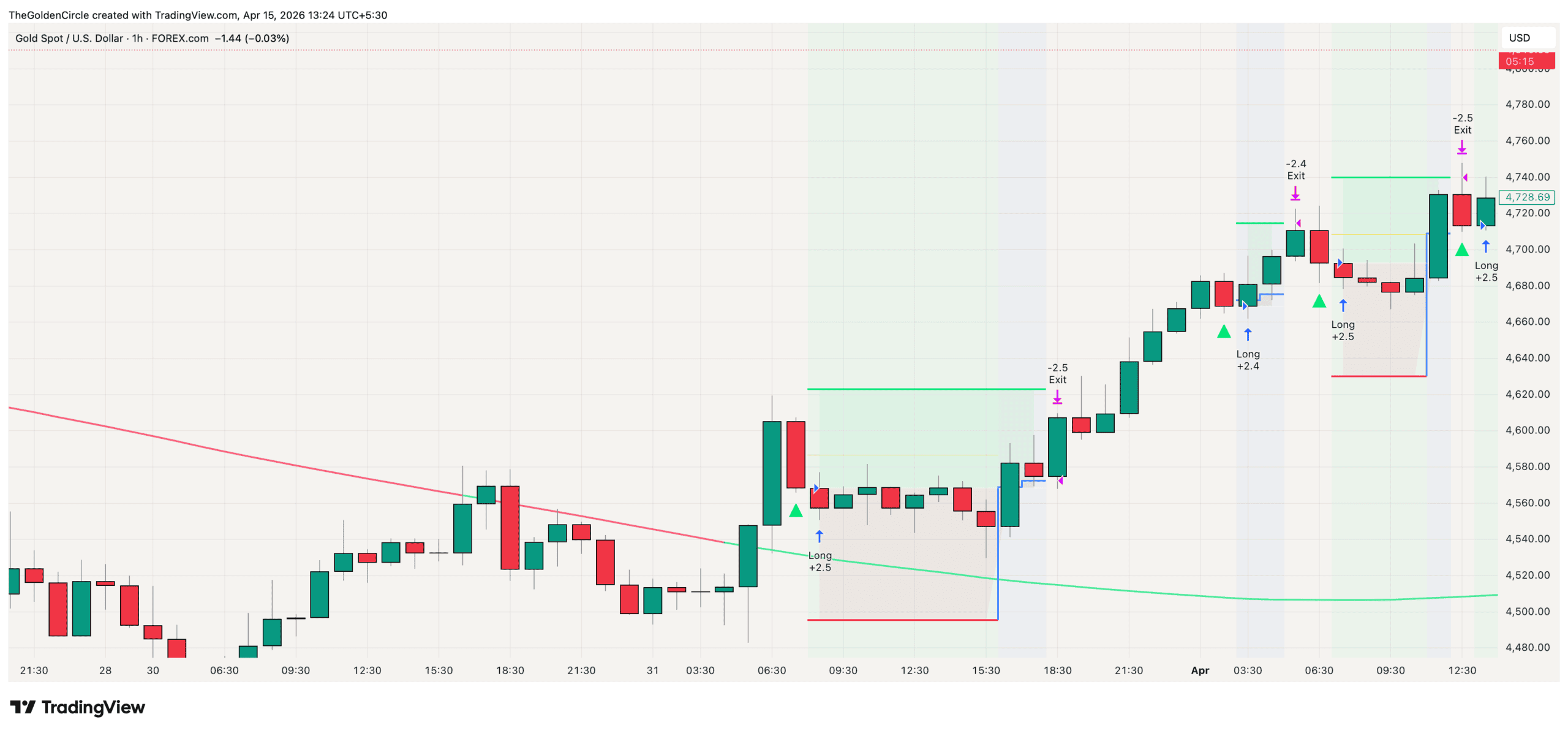
Every element labelled: entry (triangle), entry price (gray), ATR stop (red), breakeven (blue), trailing (green), take profit (teal), and the compact dashboard. The stop line transitions through red > blue > green as trade management progresses.
6. Sniper vs Aggressive Mode – Fewer Signals or More Opportunities
| Feature | Sniper Mode | Aggressive Mode |
|---|---|---|
| Filters | Core rules + forensic loss filters | Core rules only |
| Signals | Fewer, highest conviction | More frequent entries |
| Best for | Live trading, risk-conscious | Active traders, more screen time |
| Start here? | Yes – recommended default | After confidence with Sniper |
The Sniper filters came from forensic analysis of every losing trade in the backtest. I examined what those setups had in common and built additional gates to catch those patterns before they trigger. Fewer signals, but each carries higher conviction.
Direction is Long Only by default, which is recommended. Gold’s momentum edge is strongest on the bullish side.
7. Pullback Strategy vs Mean Reversion – Different Tools for Different Market Phases
This is the question I get most often from traders who already use the Gold Mean Reversion H1. When do you use this gold pullback trading strategy and when do you use mean reversion?
The answer is market phase:
| Market Phase | Best Tool | What It Does |
|---|---|---|
| Gold is trending | This pullback strategy | Buys dips within the trend at quality pullback points |
| Gold hits extreme top/bottom | Mean Reversion H1 | Catches reversal using Z-Score exhaustion signals |
| Need tighter entry timing | 1M Scalper | Pinpoints the exact entry bar on 1-minute chart |
| Want macro correlation context | Stat Arb Engine | Measures Gold vs DXY/yields divergence |
| Riding multi-day trends | Momentum Edge v9 | H4/Daily momentum continuation |
8. Where This Fits in the Complete Asligold Gold Trading System
With this release, the toolkit covers every phase of the Gold price cycle:
Statistical Arbitrage Engine – Macro context. Is Gold mispriced relative to DXY and yields?
Gold Mean Reversion H1 – Catches tops and bottoms with Ornstein-Uhlenbeck exhaustion.
Gold 1M Scalper – Precision entry timing on the 1-minute chart.
Gold Momentum Edge v9 – Momentum continuation on H4/Daily.
Gold Momentum Pullback H1 (this post) – Buys pullbacks within confirmed trends. Indicator + strategy pair.
See all tools: Asligold TradingView Indicators – Complete Gold Trading Toolkit
9. How to Get Access and Set Up Alerts
Both scripts are invite-only on TradingView. Send a DM with your TradingView username.
Recommended workflow: Get access to both. Run the strategy on your broker’s XAUUSD H1 data first. Check the Strategy Tester: equity curve, win rate, profit factor, drawdown. If the numbers work, switch to the indicator for live trading.
7 alert conditions: Entry signal fired, Take profit hit, Stop loss hit, Breakeven activated, Trailing stop activated, Stale trade exit, Time-based exit.
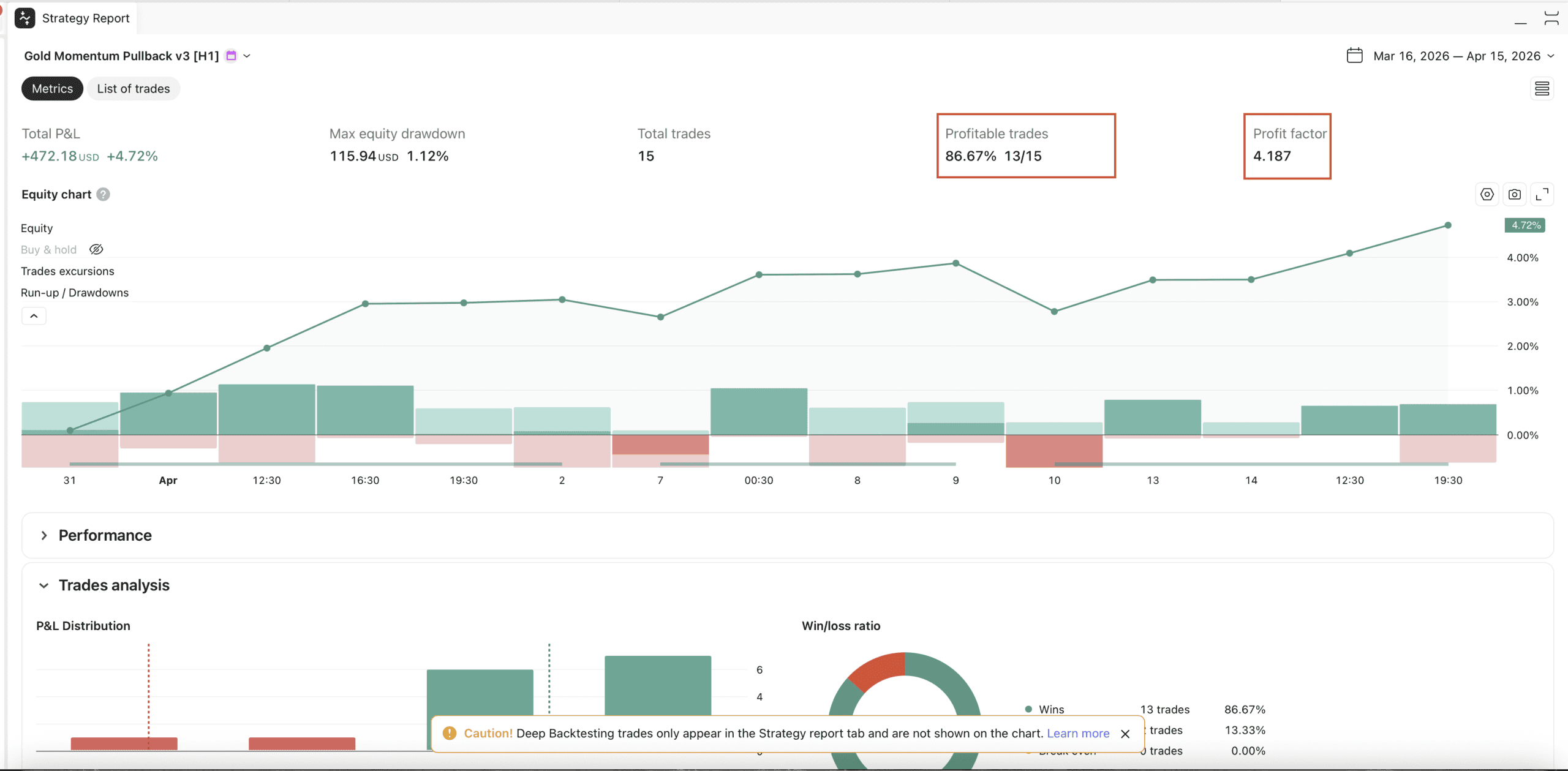
Strategy Tester output for Gold Momentum Pullback v3 on XAUUSD H1. Run this on your own broker’s data to verify the gold pullback trading strategy performs before going live. Past performance does not guarantee future results.
10. FAQ: 6 Questions About This Gold Pullback Trading Strategy
Same logic, same filters, same management. The indicator is for live trading with real-time signals and 7 alert conditions. The strategy is for backtesting in TradingView’s Strategy Tester. Use the strategy to validate, then trade with the indicator.
Because 20 years of XAUUSD data shows buying every pullback is a losing approach. RSI below 25 only bounces 34% of the time. The system uses five simultaneous filters (momentum, pullback quality, trend alignment, overextension guard, momentum quality scoring) to isolate specific dips within confirmed momentum moves. Those filtered pullbacks have a statistically significant edge.
After price moves a defined distance in your favour, the stop shifts to your entry price. Zero risk from that point. In backtesting, this converted a meaningful percentage of would-be losers into scratch trades. The SL line changes from red to blue when it activates. This single feature improved the overall risk profile more than any other setting.
The Momentum Edge v9 runs on H4/Daily and catches broader continuation moves. This pullback system runs on H1 and targets pullback re-entries within those moves. Think of v9 as the macro trend finder and this system as the tactical dip-buyer within that trend.
Sniper. It uses additional filters derived from forensic analysis of losing trades. Fewer signals, higher conviction. Run Sniper on the strategy version for 2-3 weeks first. Switch to Aggressive only after building confidence. Always paper trade before going live.
They complement each other perfectly. The mean reversion H1 and 1M scalper catch tops and bottoms. This pullback strategy rides the trend between those extremes. The overextension guard shares the same principle as the Z-Score in the mean reversion indicator. When Gold is stretched enough for mean reversion to fire, this system suppresses pullback entries simultaneously. They avoid conflicting by design.
Read next
Gold Mean Reversion Indicator [H1] – Catch Tops and Bottoms with Z-Score Exhaustion
Gold 1-Minute Scalping Indicator – Precision Entries on XAUUSD
Gold Momentum Edge v9 – H4/Daily Trend Following Strategy
Asligold TradingView Indicators – Complete Gold Trading Toolkit
Gold Price Prediction – Weekly XAUUSD Analysis
Risk Disclaimer: Trading Gold (XAUUSD) and other financial instruments carries substantial risk. Past performance, whether backtested or real-time, does not guarantee future results. The Gold Momentum Edge [H1] indicator and Gold Momentum Pullback v3 [H1] strategy are for educational and informational purposes only – they are not financial advice. Strategy Tester results are based on historical data. Always use proper position sizing and risk management. Never risk more than you can afford to lose. Paper trade for at least 2-3 weeks before committing real capital. The final trading decision is always yours. This website contains affiliate links – see full disclaimer.